Introduction
Hospitals and health care systems increasingly enter into delegated credentialing agreements with payers to streamline provider onboarding, accelerate network participation, and reduce administrative burden. Payers delegate responsibility for credentialing and recredentialing of the hospital under these arrangements and retain full regulatory accountability. Delegation introduces significant hospital–payer risks, which include audit exposure, financial penalties, and abrupt revocation of delegated status if compliance standards are not met. Understanding the structure, risks, and controls of delegated credentialing is important to sustain payer trust and operational continuity.
For more information, go through Hospital Credentialing Basics
What Are Delegated Credentialing Agreements?
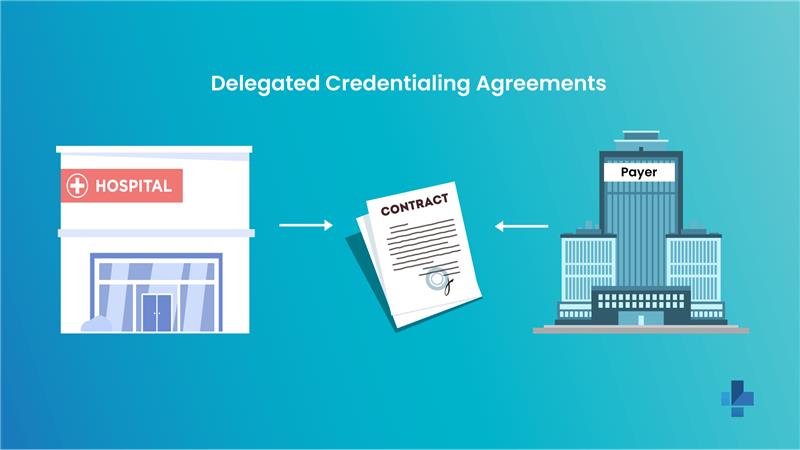
A delegated credentialing agreement is a formal contract in which a payer authorizes a hospital or health system to perform credentialing and recredentialing activities on its behalf. While operational responsibility shifts, the payer remains accountable to regulators like CMS, NCQA, and state insurance departments.
Key elements typically include:
- Defined scope of delegated activities (initial credentialing, recredentialing, and PSV)
- Required adherence to NCQA delegation standards
- Audit rights and reporting obligations
- Performance thresholds and corrective action requirements
Hospitals must follow the payer’s credentialing policies precisely, including primary source verification (PSV), committee review, and decision timelines.
For more information, visit Primary Source Verification Role
Key Risks and Pitfalls
While delegation offers efficiency, it also concentrates risk. Common delegated credentialing compliance risks include:
- Incomplete or outdated PSV (licenses, board status, sanctions)
- Failure to meet recredentialing cycle timelines
- Inadequate documentation of credentialing committee decisions
- Misalignment between hospital bylaws and payer credentialing criteria
- Poor audit preparedness or missing delegation logs
- Over-reliance on manual tracking systems
These gaps frequently surface during payer or NCQA audits, leading to delegation corrective action plans (CAPs) or, in severe cases, termination of delegated status.
Mitigation Strategies and Compliance Checklists
Hospitals can significantly reduce risk by implementing structured governance and automation. Effective mitigation strategies include:
- Maintaining payer-specific credentialing checklists
- Centralizing PSV tracking with automated alerts
- Aligning medical staff bylaws with payer delegation standards
- Conducting internal mock delegation audits quarterly
- Standardizing documentation for credentialing and recredentialing decisions
- Ensuring vendor PSV workflows meet payer approval requirements
Technology-enabled credentialing platforms can support real-time compliance, audit readiness, and reporting consistency across payer contracts.
Simplify Hospital Credentialing
Conclusion
Delegated credentialing agreements can deliver meaningful efficiencies but only when paired with rigorous compliance oversight. Hospitals that lack visibility into PSV status, audit metrics, or payer-specific rules face elevated financial and operational risk.
To reduce exposure and strengthen delegation readiness, explore medtigo Connect, which offers automated PSV tracking, delegation-specific compliance dashboards, and audit-ready reporting tailored to payer workflows.
For more information, contact support@medtigo.com
FAQs
1. What triggers automatic revocation of delegated credentialing agreements with Medicare Advantage?
Immediate revocation may occur following critical audit failures, systemic PSV deficiencies, or failure to implement corrective actions within mandated timelines.
2. Do hospitals need separate delegation agreements per payer product line (HMO vs PPO)?
Yes, many payers require separate delegation agreements or amendments for different product lines, each with distinct reporting and audit requirements.
3. How does CAQH CORE Phase IV impact delegated credentialing workflows?
CORE Phase IV enhances data exchange standards, increasing expectations for electronic verification, standardized reporting, and interoperability within delegated workflows.
4. What metrics must quarterly delegation reports include for UnitedHealthcare?
Typically required metrics include credentialing turnaround times, recredentialing compliance rates, audit findings, PSV completion rate, and corrective action status.
5. Can delegated hospitals use vendor PSV services without payer re-approval?
Not always, many payers require explicit approval of third-party PSV vendors, and unapproved vendor use may constitute a delegation breach.