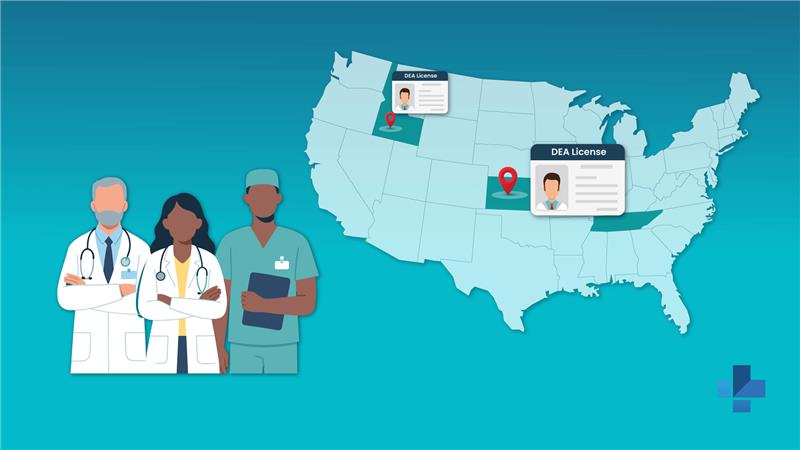
Physicians, NPs, and PAs practicing in many states, specifically those doing locum tenens, telehealth, or relocating, often ask: Do I need a separate DEA license for each state?
The short answer is yes, in most cases, you need a separate DEA registration for each state where you prescribe controlled substances. The details depend on federal rules and each state’s requirements.
If you want to simplify the entire process, medtigo Medical Licensing Service handles both federal DEA registration and state-controlled substance registrations (CSR) seamlessly, so you can focus on patient care instead of paperwork.
Start your DEA and CSR licensing process with medtigo today!
Federal DEA Rules: One Per Principal Place of Business
The Drug Enforcement Administration (DEA) regulates controlled substances under federal law.
Under federal rules:
You must have a separate DEA registration in each state where you dispense, administer, or prescribe controlled substances.
Each DEA registration is tied to a specific principal place of business in that state.
If you practice in multiple states, you must maintain multiple DEA registrations.
For example:
If you practice in Texas and Arizona → you need 2 DEA registrations.
If you relocate permanently → you must modify or transfer your DEA registration to your new state.
Federal law does not automatically allow a single DEA number to cover multiple states.
State Controlled Substance Registrations (CSR)
Many states need a separate state-level Controlled Substance Registration (CSR) in addition to federal DEA registration.
This means in most states you need:
- Active state medical license
- State Controlled Substance Registration (CSR)
- Federal DEA registration
The order of the license matters. Many states require you to obtain your state license first, then CSR, and only then can you apply for or activate DEA registration for that state. Missing one step can delay credentialing, hospital privileges, or payer enrollment.
To streamline everything, medtigo bundles federal DEA registration and state CSR applications together under medtigo Medical Licensing Service, eliminating compliance gaps.
Learn more: DEA Registration and State Licensing Guide
Transferring or Modifying Your DEA Registration
If you relocate or add a new practice location, you must update your DEA registration.
There are two common scenarios:
1. Permanent Move to Another State
You must:
Surrender your current state registration (if no longer practicing there)
Apply for a new DEA registration in your new state
2. Adding an Additional State
You must:
Apply for a completely new DEA registration for that state
Maintain separate renewals for each registration
Address changes in the same state require updating your DEA record, but moving across state lines requires a new registration.
Read more: How to Transfer Your Medical License Between States
Special Cases: NPs, PAs, and Hospital Privileges
NPs and PAs frequently ask whether they can use a supervising physician’s DEA number.
In most states:
NPs and PAs must obtain their own DEA registration if authorized to prescribe controlled substances.
Prescriptive authority depends on state scope-of-practice laws.
Hospital privileges often require proof of individual DEA registration.
If an NP or PA practices in multiple states, they must maintain:
State license(s)
State CSR(s) if required
DEA registration(s) for each state
Failure to align DEA registration with hospital credentialing can delay onboarding.
To avoid these issues, align your DEA registrations with hospital privileges by using medtigo Medical Licensing Service
Read more: NP and PA Hospital Credentialing Guide.
Renewal Timing and Compliance Pitfalls
DEA registrations are valid for 3 years, but:
State CSRs may renew annually or biennially
Renewal cycles often do not align
Expired CSRs can invalidate DEA prescribing authority in that state
Common pitfalls include:
Forgetting to renew a state CSR while the DEA remains active
Practicing at an unregistered location
Prescribing before CSR approval
Delayed updates after relocation
Managing multiple states means tracking multiple renewal deadlines.
Streamline your licensing and avoid compliance risks with medtigo Medical Licensing Service
FAQs
1. Can one DEA number cover multiple practice locations in the same state?
Generally, yes, if the locations are in the same state and properly registered as practice sites. However, some situations need additional registrations depending on how controlled substances are stored or dispensed.
2. What’s the process for temporary DEA during locum assignments?
There is no “temporary DEA.” For locum work in another state, you must obtain:
State medical license
State CSR (if required)
Separate DEA registration for that state
Planning ahead is critical to avoid delayed start dates.
3. Do NPs and PAs need separate DEA numbers from supervising physicians?
Yes, in most states, NPs and PAs authorized to prescribe controlled substances must maintain their own DEA registration.
4. How does telehealth across state lines affect DEA requirements?
If you prescribe controlled substances by telehealth to patients located in another state, you must:
Be licensed in that state
Meet that state’s CSR requirements
Maintain a DEA registration tied to that state
Telehealth does not eliminate state-based licensing or DEA requirements.
Ready to License Faster?
Managing multi-state DEA registration and CSRs doesn’t have to be overwhelming.
Visit medtigo Medical Licensing Service or email support@medtigo.com to get started today.