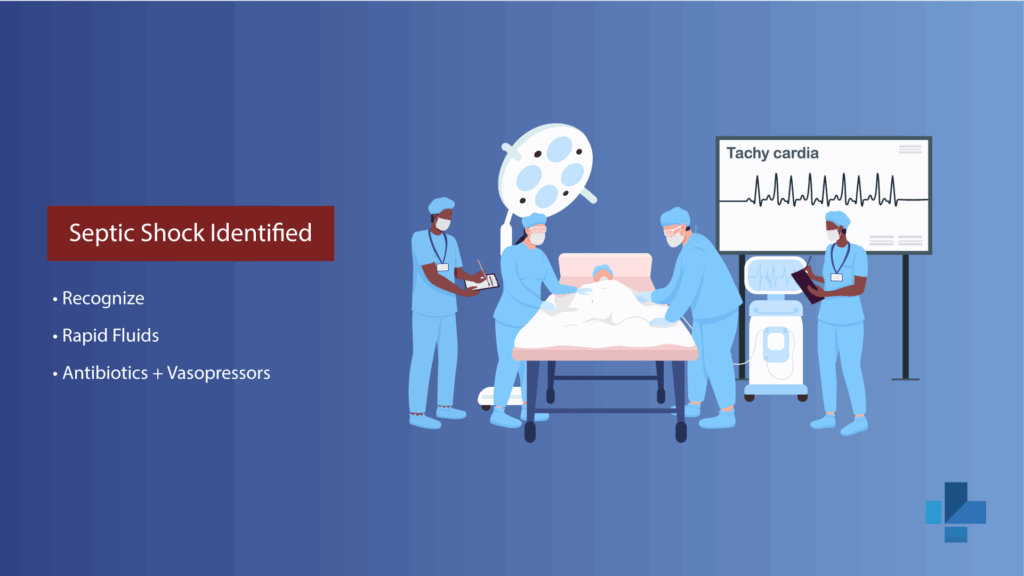
Septic shock in children progresses rapidly, and early intervention can mean the difference between recovery and cardiac arrest. The Pediatric Advanced Life Support (PALS) framework gives structured, evidence-based guidance for timely recognition and aggressive management. Understanding PALS septic shock management ensures healthcare providers move swiftly from suspicion to stabilization during pediatric sepsis resuscitation.
Introduction
Septic shock is a severe and life-threatening response to infection, which leads to circulatory failure and inadequate tissue perfusion. In children, compensation can make severity, which makes early identification critical. Under American Heart Association PALS guidelines, septic shock is treated as a time-sensitive emergency requiring rapid assessment, fluid resuscitation, antibiotics, and vasoactive support if needed.
Early septic shock recognition focuses on:
- Tachycardia disproportionate to fever
- Altered mental status
- Delayed capillary refill
- Abnormal pulses
- Hypotension (late finding)
Start the PALS Course as early as possible.
Early Recognition Signs
Children often maintain blood pressure until late in shock. Providers must detect subtle signs.
Key Pediatric Sepsis Signs (PALS Framework)
Persistent tachycardia
Cool, mottled extremities (cold shock)
Flash capillary refill (warm shock)
Weak or bounding pulses
Decreased urine output
Irritability or lethargy
Hypotension (late and ominous)
Initial Resuscitation (First 5 Minutes)
Time zero begins at recognition.
Immediate Actions:
Airway & Breathing
Administer high-flow oxygen
Prepare for an advanced airway if the mental status declines
Circulation
Establish IV or IO access within 5 minutes
Begin isotonic crystalloid bolus
Fluid Resuscitation
Give 20 mL/kg isotonic fluid bolus
Reassess after each bolus
Up to 60 mL/kg within the first hour if no signs of fluid overload
PALS septic shock fluids are administered rapidly while monitoring:
- Lung sounds
- Hepatomegaly
- Work of breathing
If fluid refractory shock persists → initiate vasoactive medications.
Stabilization Phase (Hour 1)
The first hour is often called the “Golden Hour” of pediatric sepsis.
Key Interventions:
Broad-spectrum IV antibiotics within 1 hour
Continued fluid reassessment
Start epinephrine (cold shock) or norepinephrine (warm shock) if fluid resistant
Monitor lactate and perfusion markers
Early pediatric septic shock antibiotics significantly reduce mortality. Blood cultures must be obtained before antibiotics if it does not delay administration.
PALS Algorithm Integration
The PALS sepsis algorithm integrates into the systematic approach:
- Initial Impression
- Primary Assessment (ABCDE)
- Secondary Assessment
- Diagnostic Evaluation
- Reassess & Escalate
The algorithm emphasizes:
Early recognition
Aggressive fluids
Rapid antibiotics
Vasoactive support
Continuous reassessment
Providers trained in PLAS septic shock management move through this algorithm efficiently, reducing delays in pediatric sepsis resuscitation.
medtigo PALS Online Mastery
Whether you are a nurse, physician, paramedic, or advanced practice provider, mastering pediatric septic shock requires confidence in rapid decision-making.
With medtigo PALS online course, you get:
100% online certification
Interactive shock scenarios
Step-by-step sepsis algorithms
CME credits accepted nationwide
Immediate digital provider card
Start your PALS course from medtigo pals online course
Conclusion
Mastering PALS septic shock protocols transforms early recognition into life-saving action. From tachycardia detection to 60 mL/kg fluid resuscitation and timely antibiotics, every second counts for pediatric patients.
medtigo’s 100% online PALS certification equips you with interactive scenarios, precise algorithms, and CME credits accepted nationwide.
Don’t wait for the next code; prepare today.
FAQs
1. How do you differentiate compensated vs hypotensive septic shock in infants?
Compensated shock presents with tachycardia, delayed cap refill, and poor perfusion without hypotension. Hypotensive (decompensated) shock includes low systolic BP and indicates impending cardiovascular collapse.
2. What is the first sign of shock in pediatric patients?
Tachycardia is typically the earliest and most sensitive sign of pediatric shock.
3. What is a late sign of septic shock in children?
Hypotension is a late and critical sign often occurring just before cardiovascular failure.