Introduction
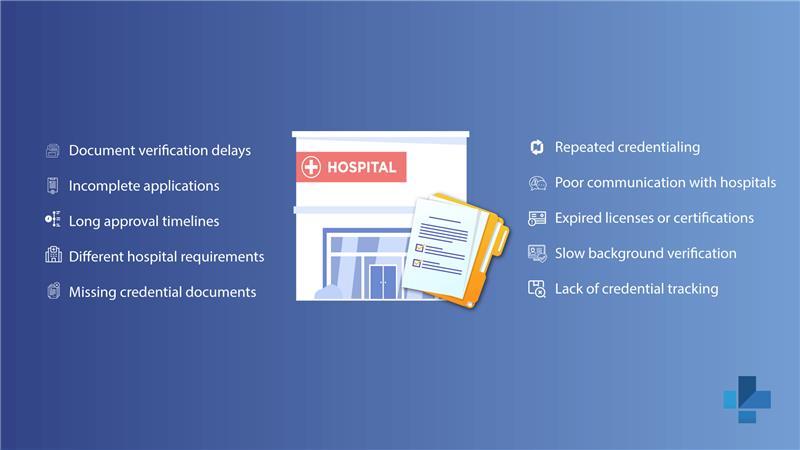
Hospital credentialing is an important and complex process that ensures healthcare professionals meet the necessary standards to deliver high-quality and safe care. Hospital credentialing challenges can significantly delay onboarding, specifically for Nurse Practitioners (NPs) and Physician Assistants (PAs) who face unique administrative and regulatory hurdles.
Many healthcare organizations rely on centralized credentialing platforms like medtigo connect to streamline credential verification, document tracking, and compliance management in facilities. These digital solutions are transforming how hospitals manage providers for onboarding and ongoing credentialing requirements.
Understanding Hospital Credentialing Basics
What is Hospital Credentialing?
Hospital credentialing is the process of verification of the qualifications of healthcare professionals, including training, education, licensure, work history, and certifications. It makes sure that providers are competent and eligible to deliver care within a healthcare organization.
Credentialing vs Privileging vs Enrollment
Understanding the differences is essential:
- Credentialing: Verification of qualifications and professional background
- Privileging: Authorization to perform specific clinical procedures
- Enrollment: Approval to bill insurance providers for services
Please visit for more information: Three Types of Credentialing
Typical Credentialing Timeline
The average credentialing timeline ranges from 90 to 180 days on the basis of institution and complexity.
Common reasons for delays include:
Primary source verification (PSV)
Committee approvals
Missing or incomplete documentation
Digital credentialing platforms can significantly reduce these timelines by automating verification and tracking processes.
Top 10 Hospital Credentialing Challenges for NPs and PAs
Advanced practice providers like NPs and PAs face different administrative barriers because of different state regulations, collaborative practice requirements, and multisite employment. Here are the most common hospital credentialing challenges for PAs and NPs and how to solve them.
1. Incomplete Curriculum Vitae
NP/PA Impact: Missing collaborative agreements or outdated CVs can delay applications.
Solution: Use structured credentialing templates and digital document tracking tools to ensure completeness.
2. Primary Source Verification Delays
NP/PA Impact: Verifying malpractice history or licenses can take more than 6 weeks.
Solution: Implement automated Primary Source Verification (PSV) systems to accelerate validation.
3. License Expiration Mismatch
NP/PA Impact: Multi-state providers struggle with misaligned renewal dates.
Solution: Use automated renewal tracking systems to monitor expiration timelines.
4. Reference Letter Delays
NP/PA Impact: Supervising physicians may delay submitting references.
Solution: Leverage centralized provider networks and digital reference submission tools.
5. Peer Review Bottlenecks
NP/PA Impact: Smaller hospitals may lack sufficient reviewers for timely evaluations.
Solution: Adopt virtual peer-review matching programs to ensure timely assessments.
6. DEA and Controlled Substance Verification
NP/PA Impact: Requirements vary by state for controlled substance registration.
Solution: Coordinate the DEA and CSR registration processes efficiently.
Learn more: What is a DEA License, and Why Do You Need One?
7. Site Visit Scheduling
NP/PA Impact: Rural or remote facilities may require on-site verification visits.
Solution: Use virtual verification and digital credentialing reviews to minimize delays.
8. Reappointment and Recredentialing Overload
NP/PA Impact: Providers must undergo credentialing reviews every 2 years.
Solution: Automate reminders and use credential tracking systems to manage deadlines.
9. Joint Commission Audit Requirements
NP/PA Impact: Hospitals must maintain extensive documentation for compliance.
Solution: Utilize compliance dashboards and automated reporting tools.
10. Multi-Hospital Credentialing Coordination
NP/PA Impact: Providers working across multiple facilities must complete duplicate applications.
Solution: Implement centralized credentialing platforms to unify and reuse provider data.
medtigo Hospital Credentialing Solutions
Centralized credentialing systems are reshaping how hospitals and providers manage onboarding and compliance. A medtigo hospital credentialing service offers an integrated solution that simplifies the entire process.
Simplify Credentialing with medtigo
medtigo Connect enables healthcare organizations to:
- Streamline document submission and verification
- Automate compliance tracking
- Reduce manual administrative workload
- Improve provider onboarding efficiency
Real Results
Healthcare organizations using digital credentialing systems report:
- Up to 90% faster credentialing approvals
- 98% audit pass rates
- Faster provider onboarding timelines
- Significant reduction in administrative burden
Simplify Hospital Credentialing with medtigo: medtigo Connect
FAQs
1. What is the average hospital credentialing timeline?
Typically, credentialing takes 90 to 180 days on the basis of verification processes and documentation completeness.
2. What are the most common reasons credentialing is delayed?
Delays are usually caused by incomplete applications, slow primary source verification, missing documents, and committee scheduling delays.
3. Do NPs and PAs go through the same credentialing process as physicians?
Yes, the core process is similar. However, NPs and PAs may face additional requirements like collaborative agreements and varying state regulations.
4. Can credentialing platforms support NPs and PAs?
Absolutely, modern platforms like medtigo Connect are designed to support all provider types, including NPs and PAs, with tailored workflows and compliance tracking.
End Credentialing Delays
Simplify hospital credentialing for NPs and PAs with medtigo and eliminate unnecessary delays in provider onboarding.
Get Credentialed Faster
Start your US medical licensing journey today
Learn more about medtigo or contact support@medtigo.com for assistance.
By adopting modern credentialing solutions, healthcare organizations can overcome administrative bottlenecks and ensure providers are ready to deliver care faster and more efficiently than ever before.