Bell’s palsy which has a unilateral and quick onset is the most common peripheral paralysis of the seventh cranial nerve. Usually determined by a physical examination the diagnosis is one of exclusion. The facial nerve is composed of three branches: intracranial extratemporal and intratemporal. The facial nerve regulates taste in the anterior two thirds of the tongue in addition to parasympathetic and motor functions. It also governs the salivary and lacrimal glands. The motor function of the peripheral facial nerve regulates both the upper and lower face muscles. Because of this assessing the strength of the forehead muscles is crucial to figuring out what caused Bell’s palsy. If forehead strength is maintained the main reason for weakening should be looked at.
Epidemiology
With 667 persons newly infected every year the prevalence is about 1.6% and the annual incidence is 4.4 to 6 per 100, 000 people. This can remiss up to 12% of the cases. Of those who have been diagnosed, seventy percent of them will respond better even without going through therapy. Even though it can develop at any age and does not discriminate against a specific ethnic or sexual group, likewise toward progressive muscle paralysis which is often observed in mid- to late-life and the peak onset age is relatively young at forty years old.
Anatomy
Pathophysiology
Bell’s palsy is thought to be caused by compression of the seventh cranial nerve at the geniculate ganglion. The narrowest part of the facial canal is its labyrinthine zone which is also where most compression cases occur. Because of the facial canal’s restricted entry and the inflammation results in nerve compression and ischemia. The most common finding
is a unilateral weakening of the face including the muscles of the forehead.
Etiology
Bell’s palsy is an idiopathic disorder. A increasing corpus of research in the literature indicates that a number of clinical conditions and diseases may be linked to a time of unilateral facial paralysis. Numerous viral infections such as the Epstein-Barr virus and herpes simplex virus and varicella-zoster virus have been found in the literature. In the setting of an assumedly established etiologic process healthcare professionals may inadvertently and imprecisely suggest a Bell’s palsy diagnosis. When there are established links as those between Lyme disease and Ramsay-Hunt syndrome this can occur. Bell’s palsy is detected in around 70% of instances of facial nerve palsies while there are other causes as well such as traumatic idiopathic autoimmune neoplastic and congenital.
Genetics
Prognostic Factors
Age: younger ones are normally characterized by more favourable outcomes in comparison to their older ones. Severity of Symptoms: Mild to moderate facial weakness has a better prognosis, but it is also dependent on the extent of facial nerve involvement at the start of the symptoms
Clinical History
Most cases of Bell’s palsy manifest often start at night. The case of the person is often paralysis or may observe that one half of the face is not moving when they wake up. There may be a stroke of the face seen on affected side due to paralysis or muscle weakness. This could be much affect movement of eyes and other facial expressions like closure and smiling.
When the affected side is being operated on, the patients may see difficulties in raising eyebrows, closing one eye or smiling.
Physical Examination
Face motions assessment
Examining the patient’s eyes
Wrinkling on the forehead
Taste assessment.
Age group
Associated comorbidity
Associated activity
Acuity of presentation
Bell’s palsy often manifests suddenly taking hours or even days to manifest. One typical complaint is that when they wake up or notice it during the day one side of their face seems weak or paralysed. Once symptoms begin they might get worse fast and culminating in a few days. Bell’s palsy advances more rapidly than other forms of facial paralysis such stroke which may begin more gradually.
Although the extent of the initial Bell’s palsy symptoms might differ they commonly comprise facial paralysis or lack of strength exhibited exclusively on the right or the left side of the face. Some of the people may develop some obvious signs of facial asymmetry when the disease reaches a severe stage. The one side of the face may droop. It may seem more plausible to consider this asymmetry when you are trying to close your eyes or pull a smile.
Differential Diagnoses
Ramsay Hunt syndrome
Lyme disease
Guillain-Barré syndrome
Laboratory Studies
Imaging Studies
Procedures
Histologic Findings
Staging
Treatment Paradigm
Eye care: The patients with Bell’s palsy are prone to scratches on the eyelid due to reduced production of tears and inability for eyelids to close. Such conditions lead to abrasion stuff and ocular disorders.
Physical therapy: Physical therapy techniques such as facial exercises, massage and electrical stimulation are helpful, they are used to help patients strengthen, gain mobility and coordination of facial muscles, hence, the giving of the patient the highest chance of a good recovery of facial function.
Antiviral therapy: Antiviral agents for the therapy of Bell’s palsy are efficient especially where the HSV reactivation is thought to be the causative agent of the disease.
Moist heat therapy: Using warm compresses or moist heat packs by putting them on the side of the face that is affected can help in relieving pain, easing the stiffness in the muscles and ultimately relaxing the facial muscles.
Fall prevention: Individuals including this group may encounter troubles related to equilibrium and motor control, for example, the facial muscles are not powerful enough or numb.
Clutter space: By eliminating toxins around an older person’s living space you can reduce their risk of falling and injuring themselves. Loose rugs clutter and uneven surfaces are the common bedfellows of the decreasing space. Optimizing lighting: Weak or lacking illumination would cause problems for people with Bell’s palsy when it comes to perception of depth and therefore to move around. So it’s important to maintain lighting.
Assistive devices: It could be manual and dental care or computer and phone use therefore an involvement of the assistive devices is recommended. In cases of very light facial weakness or paralysis individuals with Bell’s palsy could be able to carry out their usual daily activities but they will do them more safety and successfully.
Eye protection: The patients of Bell’s palsy may not be able to blink and produce tears which may result in irritation or tear waste and corneal damage.
Facial protection: In order to avoid infections and blows to the affected side of the face people with Bell’s Palsy might need to be extra careful during intense physical activities that pose risk of blows and pressures.
Effectiveness of Corticosteroids in treating bell palsy
Prednisone are administered as the initial therapy against the condition of Bell’s palsy. They function in reducing inflammation and edema around facial nerve, which not only brings an ease against the symptoms but also recover the nerve further.
Effectiveness of Antiviral drugs in treating bell palsy
Acyclovir is a prodrug that stops viruses from growing by blocking the thymidine kinase.
Acyclovir is used by herpes virus TK as a purine nucleoside, but not by host cell TK, which transforms it into a nucleotide analogue called acyclovir monophosphate.
Face Nerve Decompression Surgery: This surgical technique may be an option for those with complex or deteriorating instances of Bell’s palsy. As a last option individuals may also have the surgery performed if conservative therapies like corticosteroids and physical therapy do not produce a satisfying result. Surgery involving facial nerve decompression spurs frequently involves general anaesthesia. When nerve compression occurs in many locations and at varying degrees of concern the surgeon may choose to use a different surgical method.
use-of-phases-in-managing-bell-palsy
Acute phase: Rearing and definitive diagnosis of Bell’s palsy using clinical manifestations or exclusion of alternate root causes of paralysis of facial nerves. Subacute phase: Beginning the physical therapy interventions, including, face exercises, massage, and electrical stimulations to ameliorate the facial movement, muscle strength and coordination.
Bell’s palsy which has a unilateral and quick onset is the most common peripheral paralysis of the seventh cranial nerve. Usually determined by a physical examination the diagnosis is one of exclusion. The facial nerve is composed of three branches: intracranial extratemporal and intratemporal. The facial nerve regulates taste in the anterior two thirds of the tongue in addition to parasympathetic and motor functions. It also governs the salivary and lacrimal glands. The motor function of the peripheral facial nerve regulates both the upper and lower face muscles. Because of this assessing the strength of the forehead muscles is crucial to figuring out what caused Bell’s palsy. If forehead strength is maintained the main reason for weakening should be looked at.
With 667 persons newly infected every year the prevalence is about 1.6% and the annual incidence is 4.4 to 6 per 100, 000 people. This can remiss up to 12% of the cases. Of those who have been diagnosed, seventy percent of them will respond better even without going through therapy. Even though it can develop at any age and does not discriminate against a specific ethnic or sexual group, likewise toward progressive muscle paralysis which is often observed in mid- to late-life and the peak onset age is relatively young at forty years old.
Bell’s palsy is thought to be caused by compression of the seventh cranial nerve at the geniculate ganglion. The narrowest part of the facial canal is its labyrinthine zone which is also where most compression cases occur. Because of the facial canal’s restricted entry and the inflammation results in nerve compression and ischemia. The most common finding
is a unilateral weakening of the face including the muscles of the forehead.
Bell’s palsy is an idiopathic disorder. A increasing corpus of research in the literature indicates that a number of clinical conditions and diseases may be linked to a time of unilateral facial paralysis. Numerous viral infections such as the Epstein-Barr virus and herpes simplex virus and varicella-zoster virus have been found in the literature. In the setting of an assumedly established etiologic process healthcare professionals may inadvertently and imprecisely suggest a Bell’s palsy diagnosis. When there are established links as those between Lyme disease and Ramsay-Hunt syndrome this can occur. Bell’s palsy is detected in around 70% of instances of facial nerve palsies while there are other causes as well such as traumatic idiopathic autoimmune neoplastic and congenital.
Age: younger ones are normally characterized by more favourable outcomes in comparison to their older ones. Severity of Symptoms: Mild to moderate facial weakness has a better prognosis, but it is also dependent on the extent of facial nerve involvement at the start of the symptoms
Most cases of Bell’s palsy manifest often start at night. The case of the person is often paralysis or may observe that one half of the face is not moving when they wake up. There may be a stroke of the face seen on affected side due to paralysis or muscle weakness. This could be much affect movement of eyes and other facial expressions like closure and smiling.
When the affected side is being operated on, the patients may see difficulties in raising eyebrows, closing one eye or smiling.
Face motions assessment
Examining the patient’s eyes
Wrinkling on the forehead
Taste assessment.
Bell’s palsy often manifests suddenly taking hours or even days to manifest. One typical complaint is that when they wake up or notice it during the day one side of their face seems weak or paralysed. Once symptoms begin they might get worse fast and culminating in a few days. Bell’s palsy advances more rapidly than other forms of facial paralysis such stroke which may begin more gradually.
Although the extent of the initial Bell’s palsy symptoms might differ they commonly comprise facial paralysis or lack of strength exhibited exclusively on the right or the left side of the face. Some of the people may develop some obvious signs of facial asymmetry when the disease reaches a severe stage. The one side of the face may droop. It may seem more plausible to consider this asymmetry when you are trying to close your eyes or pull a smile.
Ramsay Hunt syndrome
Lyme disease
Guillain-Barré syndrome
Eye care: The patients with Bell’s palsy are prone to scratches on the eyelid due to reduced production of tears and inability for eyelids to close. Such conditions lead to abrasion stuff and ocular disorders.
Physical therapy: Physical therapy techniques such as facial exercises, massage and electrical stimulation are helpful, they are used to help patients strengthen, gain mobility and coordination of facial muscles, hence, the giving of the patient the highest chance of a good recovery of facial function.
Antiviral therapy: Antiviral agents for the therapy of Bell’s palsy are efficient especially where the HSV reactivation is thought to be the causative agent of the disease.
Moist heat therapy: Using warm compresses or moist heat packs by putting them on the side of the face that is affected can help in relieving pain, easing the stiffness in the muscles and ultimately relaxing the facial muscles.
Neurology
Ophthalmology
Fall prevention: Individuals including this group may encounter troubles related to equilibrium and motor control, for example, the facial muscles are not powerful enough or numb.
Clutter space: By eliminating toxins around an older person’s living space you can reduce their risk of falling and injuring themselves. Loose rugs clutter and uneven surfaces are the common bedfellows of the decreasing space. Optimizing lighting: Weak or lacking illumination would cause problems for people with Bell’s palsy when it comes to perception of depth and therefore to move around. So it’s important to maintain lighting.
Assistive devices: It could be manual and dental care or computer and phone use therefore an involvement of the assistive devices is recommended. In cases of very light facial weakness or paralysis individuals with Bell’s palsy could be able to carry out their usual daily activities but they will do them more safety and successfully.
Eye protection: The patients of Bell’s palsy may not be able to blink and produce tears which may result in irritation or tear waste and corneal damage.
Facial protection: In order to avoid infections and blows to the affected side of the face people with Bell’s Palsy might need to be extra careful during intense physical activities that pose risk of blows and pressures.
Prednisone are administered as the initial therapy against the condition of Bell’s palsy. They function in reducing inflammation and edema around facial nerve, which not only brings an ease against the symptoms but also recover the nerve further.
Acyclovir is a prodrug that stops viruses from growing by blocking the thymidine kinase.
Acyclovir is used by herpes virus TK as a purine nucleoside, but not by host cell TK, which transforms it into a nucleotide analogue called acyclovir monophosphate.
Neurology
Otolaryngology
Face Nerve Decompression Surgery: This surgical technique may be an option for those with complex or deteriorating instances of Bell’s palsy. As a last option individuals may also have the surgery performed if conservative therapies like corticosteroids and physical therapy do not produce a satisfying result. Surgery involving facial nerve decompression spurs frequently involves general anaesthesia. When nerve compression occurs in many locations and at varying degrees of concern the surgeon may choose to use a different surgical method.
Neurology
Acute phase: Rearing and definitive diagnosis of Bell’s palsy using clinical manifestations or exclusion of alternate root causes of paralysis of facial nerves. Subacute phase: Beginning the physical therapy interventions, including, face exercises, massage, and electrical stimulations to ameliorate the facial movement, muscle strength and coordination.
Bell’s palsy which has a unilateral and quick onset is the most common peripheral paralysis of the seventh cranial nerve. Usually determined by a physical examination the diagnosis is one of exclusion. The facial nerve is composed of three branches: intracranial extratemporal and intratemporal. The facial nerve regulates taste in the anterior two thirds of the tongue in addition to parasympathetic and motor functions. It also governs the salivary and lacrimal glands. The motor function of the peripheral facial nerve regulates both the upper and lower face muscles. Because of this assessing the strength of the forehead muscles is crucial to figuring out what caused Bell’s palsy. If forehead strength is maintained the main reason for weakening should be looked at.
With 667 persons newly infected every year the prevalence is about 1.6% and the annual incidence is 4.4 to 6 per 100, 000 people. This can remiss up to 12% of the cases. Of those who have been diagnosed, seventy percent of them will respond better even without going through therapy. Even though it can develop at any age and does not discriminate against a specific ethnic or sexual group, likewise toward progressive muscle paralysis which is often observed in mid- to late-life and the peak onset age is relatively young at forty years old.
Bell’s palsy is thought to be caused by compression of the seventh cranial nerve at the geniculate ganglion. The narrowest part of the facial canal is its labyrinthine zone which is also where most compression cases occur. Because of the facial canal’s restricted entry and the inflammation results in nerve compression and ischemia. The most common finding
is a unilateral weakening of the face including the muscles of the forehead.
Bell’s palsy is an idiopathic disorder. A increasing corpus of research in the literature indicates that a number of clinical conditions and diseases may be linked to a time of unilateral facial paralysis. Numerous viral infections such as the Epstein-Barr virus and herpes simplex virus and varicella-zoster virus have been found in the literature. In the setting of an assumedly established etiologic process healthcare professionals may inadvertently and imprecisely suggest a Bell’s palsy diagnosis. When there are established links as those between Lyme disease and Ramsay-Hunt syndrome this can occur. Bell’s palsy is detected in around 70% of instances of facial nerve palsies while there are other causes as well such as traumatic idiopathic autoimmune neoplastic and congenital.
Age: younger ones are normally characterized by more favourable outcomes in comparison to their older ones. Severity of Symptoms: Mild to moderate facial weakness has a better prognosis, but it is also dependent on the extent of facial nerve involvement at the start of the symptoms
Most cases of Bell’s palsy manifest often start at night. The case of the person is often paralysis or may observe that one half of the face is not moving when they wake up. There may be a stroke of the face seen on affected side due to paralysis or muscle weakness. This could be much affect movement of eyes and other facial expressions like closure and smiling.
When the affected side is being operated on, the patients may see difficulties in raising eyebrows, closing one eye or smiling.
Face motions assessment
Examining the patient’s eyes
Wrinkling on the forehead
Taste assessment.
Bell’s palsy often manifests suddenly taking hours or even days to manifest. One typical complaint is that when they wake up or notice it during the day one side of their face seems weak or paralysed. Once symptoms begin they might get worse fast and culminating in a few days. Bell’s palsy advances more rapidly than other forms of facial paralysis such stroke which may begin more gradually.
Although the extent of the initial Bell’s palsy symptoms might differ they commonly comprise facial paralysis or lack of strength exhibited exclusively on the right or the left side of the face. Some of the people may develop some obvious signs of facial asymmetry when the disease reaches a severe stage. The one side of the face may droop. It may seem more plausible to consider this asymmetry when you are trying to close your eyes or pull a smile.
Ramsay Hunt syndrome
Lyme disease
Guillain-Barré syndrome
Eye care: The patients with Bell’s palsy are prone to scratches on the eyelid due to reduced production of tears and inability for eyelids to close. Such conditions lead to abrasion stuff and ocular disorders.
Physical therapy: Physical therapy techniques such as facial exercises, massage and electrical stimulation are helpful, they are used to help patients strengthen, gain mobility and coordination of facial muscles, hence, the giving of the patient the highest chance of a good recovery of facial function.
Antiviral therapy: Antiviral agents for the therapy of Bell’s palsy are efficient especially where the HSV reactivation is thought to be the causative agent of the disease.
Moist heat therapy: Using warm compresses or moist heat packs by putting them on the side of the face that is affected can help in relieving pain, easing the stiffness in the muscles and ultimately relaxing the facial muscles.
Neurology
Ophthalmology
Fall prevention: Individuals including this group may encounter troubles related to equilibrium and motor control, for example, the facial muscles are not powerful enough or numb.
Clutter space: By eliminating toxins around an older person’s living space you can reduce their risk of falling and injuring themselves. Loose rugs clutter and uneven surfaces are the common bedfellows of the decreasing space. Optimizing lighting: Weak or lacking illumination would cause problems for people with Bell’s palsy when it comes to perception of depth and therefore to move around. So it’s important to maintain lighting.
Assistive devices: It could be manual and dental care or computer and phone use therefore an involvement of the assistive devices is recommended. In cases of very light facial weakness or paralysis individuals with Bell’s palsy could be able to carry out their usual daily activities but they will do them more safety and successfully.
Eye protection: The patients of Bell’s palsy may not be able to blink and produce tears which may result in irritation or tear waste and corneal damage.
Facial protection: In order to avoid infections and blows to the affected side of the face people with Bell’s Palsy might need to be extra careful during intense physical activities that pose risk of blows and pressures.
Prednisone are administered as the initial therapy against the condition of Bell’s palsy. They function in reducing inflammation and edema around facial nerve, which not only brings an ease against the symptoms but also recover the nerve further.
Acyclovir is a prodrug that stops viruses from growing by blocking the thymidine kinase.
Acyclovir is used by herpes virus TK as a purine nucleoside, but not by host cell TK, which transforms it into a nucleotide analogue called acyclovir monophosphate.
Neurology
Otolaryngology
Face Nerve Decompression Surgery: This surgical technique may be an option for those with complex or deteriorating instances of Bell’s palsy. As a last option individuals may also have the surgery performed if conservative therapies like corticosteroids and physical therapy do not produce a satisfying result. Surgery involving facial nerve decompression spurs frequently involves general anaesthesia. When nerve compression occurs in many locations and at varying degrees of concern the surgeon may choose to use a different surgical method.
Neurology
Acute phase: Rearing and definitive diagnosis of Bell’s palsy using clinical manifestations or exclusion of alternate root causes of paralysis of facial nerves. Subacute phase: Beginning the physical therapy interventions, including, face exercises, massage, and electrical stimulations to ameliorate the facial movement, muscle strength and coordination.
Both our subscription plans include Free CME/CPD AMA PRA Category 1 credits.
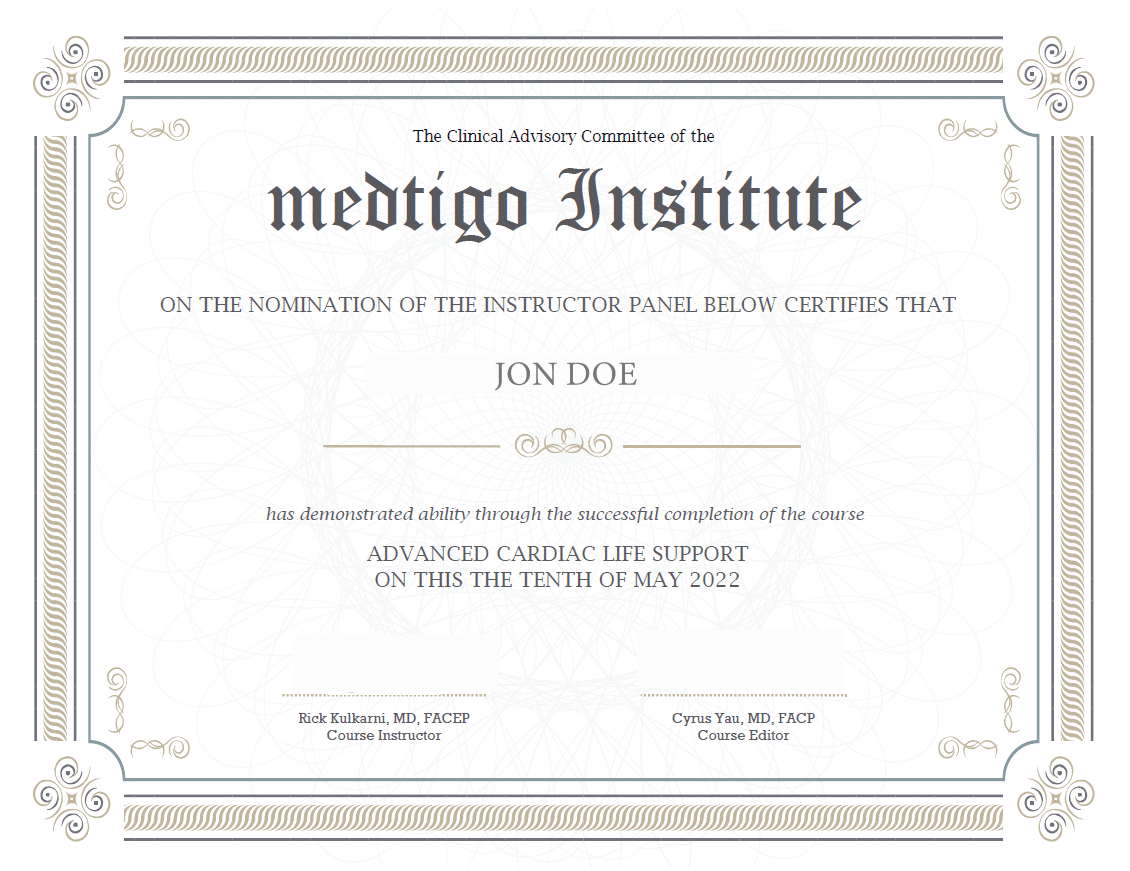
Digital Certificate PDF
On course completion, you will receive a full-sized presentation quality digital certificate.
medtigo Simulation
A dynamic medical simulation platform designed to train healthcare professionals and students to effectively run code situations through an immersive hands-on experience in a live, interactive 3D environment.
medtigo Points
medtigo points is our unique point redemption system created to award users for interacting on our site. These points can be redeemed for special discounts on the medtigo marketplace as well as towards the membership cost itself.
Community Forum post/reply = 5 points
*Redemption of points can occur only through the medtigo marketplace, courses, or simulation system. Money will not be credited to your bank account. 10 points = $1.
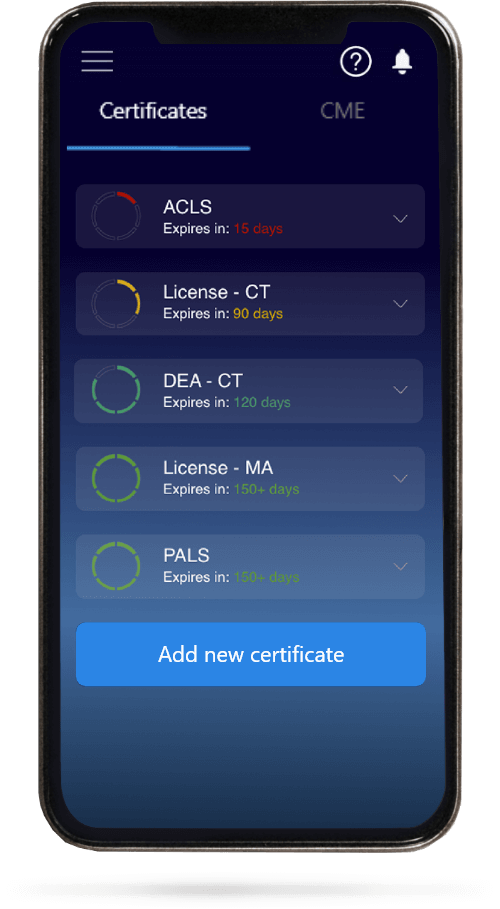
All Your Certificates in One Place
When you have your licenses, certificates and CMEs in one place, it's easier to track your career growth. You can easily share these with hospitals as well, using your medtigo app.