A 2026 Airline Water Study published by the Center for Food as Medicine and Longevity found that the quality of drinking water provided on commercial flights varies widely by airline, with many airlines continuing to supply passengers with potentially unsafe water in violation of federal regulations.
The study evaluated airline compliance with the Aircraft Drinking Water Rule (ADWR), a federal regulation implemented in 2011 that requires airlines to provide safe drinking water for passengers and crew. Despite the rule’s existence for more than a decade, the new analysis suggests that water safety problems persist across much of the airline industry.
The researchers consider the airline’s compliance with the Aircraft Drinking Water Rule (ADWR), a federal law that appeared in 2011 and stipulates the provision of safe drinking water to passengers and crew by the airlines. Although the rule is more than a decade old, the new analysis indicates that issues of water safety remain in most of the industry.
Compliance data from October 1, 2022, through September 30, 2025, were analyzed, and 10 major airlines and 11 regional airlines were ranked using a composite water safety score ranging from 0.00 to 5.00. Scores were calculated using five weighted criteria: violations per aircraft, maximum contaminant level (MCL) violations for Escherichia coli, rates of total coliform indicator positivity, public notification practices, and the frequency of aircraft water tank disinfection and flushing. A score of 3.5 or higher corresponded to a Grade A or B, indicating relatively safe and clean water.
Among major airlines, Delta Air Lines (5.00, Grade A) and Frontier Airlines (4.80, Grade A) are the top-performing major airlines, with Alaska Airlines (3.85, Grade B) placing third. Among regional carriers, GoJet Airlines (3.85, Grade B) was the best performer. In contrast, American Airlines (1.75, Grade D) scored the lowest among major airlines, and Mesa Airlines (1.35, Grade F) last among regional ones. CommuteAir recorded the second-highest total coliform positivity rate at 33.33%.
Charles Platkin, PhD, JD, MPH, director of the Center, said that Delta Air Lines and Frontier Airlines ranked first and second, respectively, for providing the safest onboard drinking water. With the exception of GoJet Airlines, nearly all regional airlines require substantial improvements in onboard water safety practices.
The study analyzed 35,674 sample locations across all airlines for total coliform bacteria. Of these, 949 sites (2.66%) tested positive, indicating potential contamination and the possible presence of disease-causing organisms. Additionally, 32 MCL violations for E. coli were identified, which had the greatest negative impact on airline scores.
Under the ADWR, airlines are required to test aircraft water tanks annually for coliform bacteria and either disinfect and flush tanks four times per year or disinfect and flush once annually with monthly testing. In case the samples are positive, there are strict schedules of repeat testing, shutdown of the systems, and taking corrective measures. The report also criticized the federal regulation and assigned a “Shame on You” to the U.S. Environmental Protection Agency, citing the rarity of civil penalties for ADWR violations.
Aircraft water systems are particularly vulnerable to contamination due to water stagnation, temperature fluctuations, and reliance on diverse water sources and transfer systems at domestic and international airports. The researchers reported that contamination was more prevalent among regional airlines, with 4.75% of sample sites testing positive for total coliform bacteria, compared with 1.89% among major airlines.
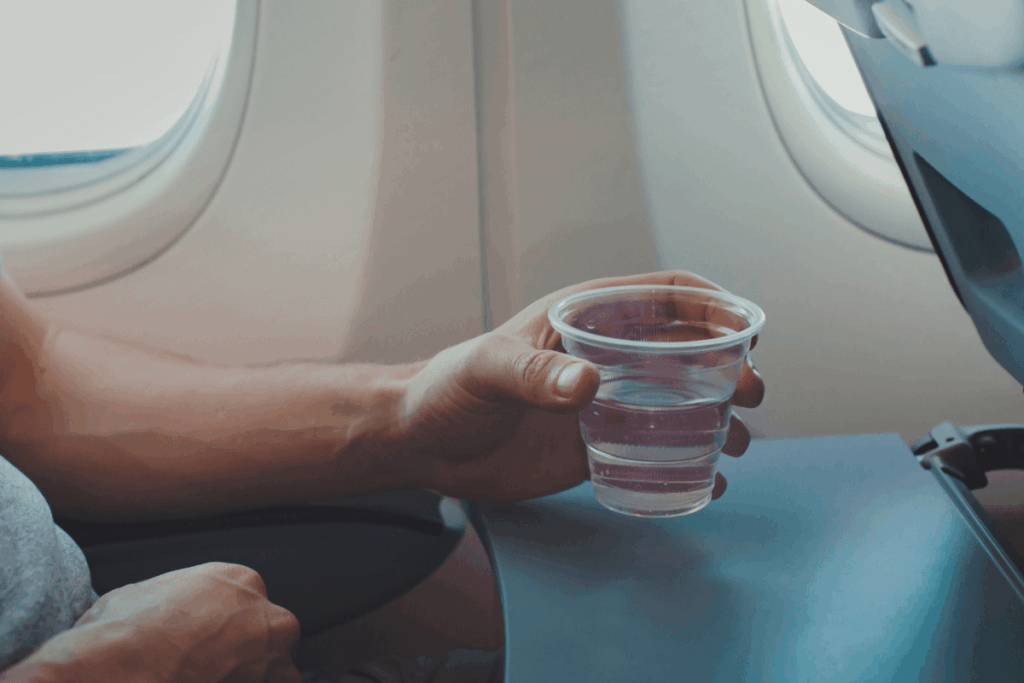
Although the research points out that the compliance data cannot be used to predict water quality on any specific flight, the study offers practical risk-reduction advice for passengers: avoid drinking unsealed onboard water, refrain from consuming coffee or tea made with aircraft water, and wash hands with soap and water rather than relying on alcohol-based hand sanitizers with less than 60% alcohol. Overall, these findings highlight ongoing public health concerns and suggest the need for stronger enforcement, greater transparency, and continuous monitoring to ensure safe drinking water on commercial aircraft.
Reference: Platkin C. 2026 Center for Food as Medicine & Longevity Airline Water Study. Center For Food As Medicine & Longevity. Published December 29, 2025. Accessed January 6, 2026. 2026 Center for Food as Medicine & Longevity Airline Water Study —