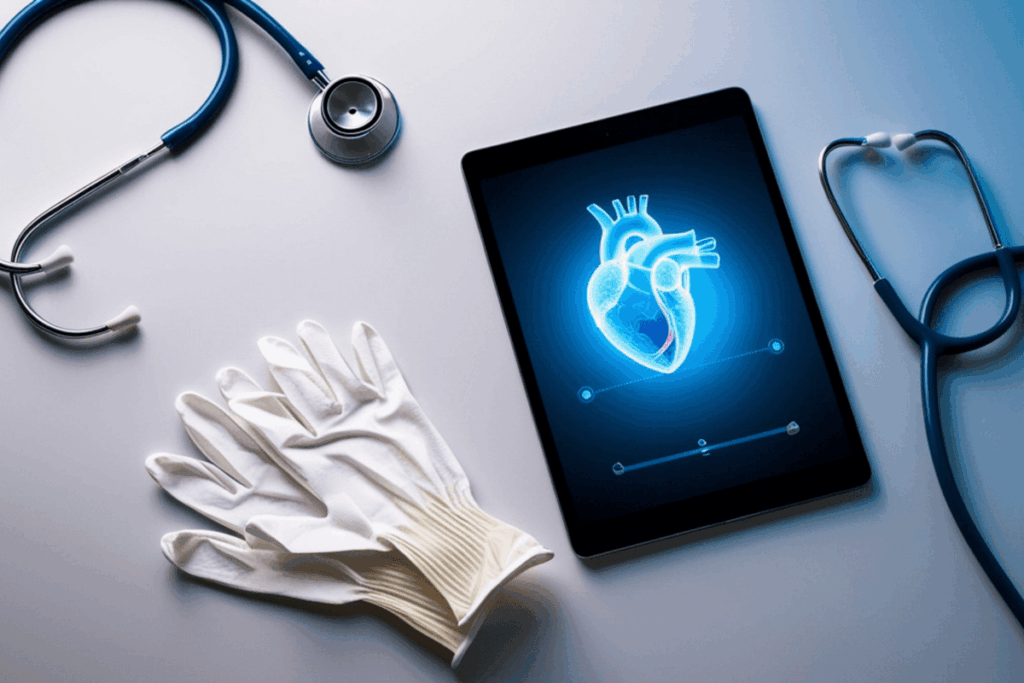
Undiagnosed valvular heart disease (VHD) affects over 50% of adults aged ≥ 65 years, with moderate or worse disease in 6.4% of adults. VHD can lead to a reduction in functional capacity, death, hospitalization, heart failure, and arrhythmia. Symptoms are often non-specific, and more than half of moderate to severe cases are asymptomatic, causing delayed treatment and diagnosis, as well as increased medical costs. Cardiac murmurs can indicate underlying VHD. However, traditional auscultation detects significant disease in only 44% of asymptomatic patients, leaving many cases undetected. A recent study published in the European Heart Journal – Digital Health evaluated the real-world performance of FDA-cleared AI algorithms that use a digital stethoscope to identify and characterize cardiac murmurs.
In this single-blinded, single-arm, prospective study (NCT05459545), 357 patients (≥50 years) were recruited across the three primary care clinics from June 2021 to May 2023. All participants were at risk for or had known heart disease but had no prior diagnosis of VHD or murmur history. Demographic data were collected for 99.2% of patients (n = 354, median age = 70 years, female = 61.9%). Included patients had one or more risk factors such as myocardial infarction, diabetes mellitus (n = 141), atrial fibrillation, prior coronary angiography, and prior coronary surgery, stroke, hyperlipidemia (n = 251), hypertension (n = 292), or body mass index of ≥30. Each participant underwent four-point cardiac auscultation through I) trained coordinators using digital stethoscopes for collecting phonocardiograms for AI analysis, II) primary care healthcare practitioners using standard of care (SOC) stethoscopes.
Examinations were considered positive if there was a murmur at any auscultation site. Echocardiography was performed for all patients to confirm moderate or worse VHD. An expert panel independently examined all phonocardiogram (PCG) recordings for audible murmurs. Ground truth was defined as the presence of an audible murmur paired with echocardiographically confirmed moderate or worse VHD. Fisher’s exact test was used for assessing the sensitivity and specificity of AI-augmented against standard auscultation, and an independent study was conducted based solely on echocardiographic findings.
Results demonstrated that with AI augmentation, sensitivity for detecting audible VHD increased from 46.2% to 92.3% with a statistically significant p-value of 0.01. Sensitivity for echocardiographically confirmed VHD increased from 13.8% to 39.7%, also reaching statistical significance with a p-value of 0.01. Specificity declined modestly from 95.6% to 86.9% and from 94.7% to 88.6%, with p <0.001. Notably, AI-augmented auscultation detected 12 patients with previously undiagnosed clinically significant VHD, compared to only six detected by SOC auscultation. Overall, these findings reported that AI-enabled digital stethoscopes substantially outperform conventional auscultation, supporting earlier clinical identification of VHD in primary care centers.
This study’s limitations include a small sample size that restricted subgroup analyses, enrollment from only three geographically localized primary care clinics, incomplete symptom data, and incomplete demographic data, as well as potential limits to generalizability. Despite these limitations, these findings offer meaningful real-world evidence supporting the clinical utility of a commercially available, easy-to-use, AI-enabled point-of-care tool for the detection of VHD.
Reference: Rancier M, Israel I, Monickam V, et al. Artificial intelligence–enabled digital stethoscope improves point-of-care screening for moderate-to-severe valvular heart disease. Eur Heart J Digit Health. 2026;7(2):ztag003. doi:10.1093/ehjdh/ztag003