Neurological disorders such as Parkinson’s disease (PD), stroke, and amyotrophic lateral sclerosis (ALS) often lead to dysarthria, a motor speech disorder that severely affects the quality of life and communication. Currently available augmentative and alternative communication (AAC) technologies are generally invasive, slow, or cognitively demanding. These systems include brain-computer interface (BCI) and head/eye-tracking devices. Wearable silent speech devices offer a portable and non-invasive alternative technology for individuals with dysarthria. However, most existing systems are validated mainly in healthy subjects and support only fragmented communication, limiting the natural speech flow and increasing user fatigue. These challenges are addressed through the development of an artificial intelligence (AI) driven intelligent throat (IT) system that captures the vibrations of the extrinsic laryngeal muscle and carotid pulse signals to decode silent speech and emotional states in real time.
In this study, a total of five stroke patients with dysarthria (mean age = 43±7.8 years, female = 1, male = 4) and ten healthy subjects (mean age = 25.3±4.1 years, female = 4, male = 6) were included. A therapist-derived corpus consisting of 20 sentences and 47 Chinese words was randomly selected. Healthy adults provided 50 sentences and 100 words of repetition, whereas patients provided 50 each, with synchronized pulse recordings.
Graphene-based textile strain sensors were fabricated using polyurethane acrylate layers, screen-printed graphene, and silver on a polyester-spandex substrate. Graphene ink was prepared from graphite powder exfoliated in isopropyl alcohol with ethyl cellulose and processed by high-pressure homogenization. The printed sensors showed long-term durability under repeated bending/stretching, stable performance up to 150 Hz, and high consistency (gauge factor approximately 100). A custom wireless printed circuit board with Bluetooth, microcontroller, and signal conditioning enabled real-time data transmission. The integrated wearable system demonstrated high comfort, reliable signal separation of silent speech and pulse signals, as well as robustness during continuous use in dysarthria studies.
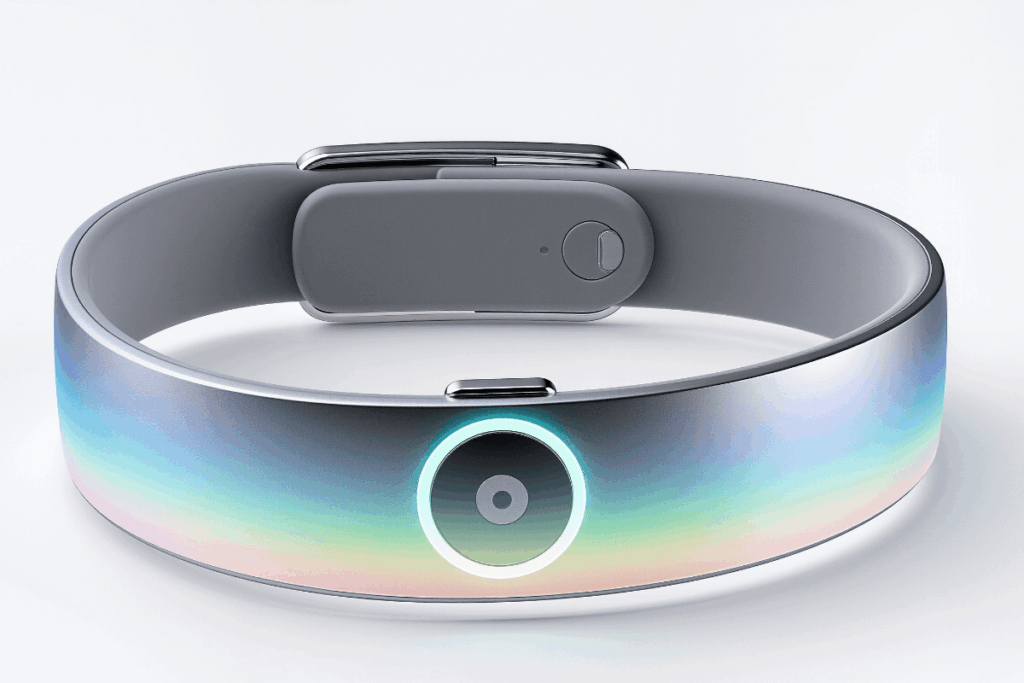
The IT system contains both software and hardware. The software contains LLM agents and machine learning models, while the hardware consists of a smart textile choker with a wireless printed circuit board (PCB) and two strain-sensing channels (carotid artery and throat center). Graphene-based sensors detect muscle vibrations at strains as low as 0.1%. A polyurethane acrylate strain isolation layer reduces external strain transfer to <1% and suppresses crosstalk by over 20 dB.
The PCB supports bi-channel acquisition of silent speech and pulse signals, operating at a total power consumption of 76.5 mW with a 1800 mWh battery enabling all-day use. Speech signals are segmented into 144 ms tokens, enabling continuous decoding without pauses. Using context augmentation (15 tokens/sample), a lightweight one-dimensional convolutional neural network achieves 92.2% token accuracy after few-shot learning. Knowledge distillation reduces computation by 75.6% with minimal accuracy loss.
Pulse-based emotion decoding classifies three emotional states with an accuracy of 83.2%. Token synthesis and sentence expansion LLM agents reduce the word error rate to 4.2% and increase patient satisfaction by 55%, delivering natural and emotionally expressive communication with a latency of less than one second.
In conclusion, beyond daily communication, the IT system supports holistic neurological care by improving social engagement, reducing depression/isolation, and enabling personalized rehabilitation feedback. Future research must be focused on validating sentence expansion in larger patient cohorts using patient-reported outcomes and objective performance metrics to ensure broad clinical applicability.
Reference: Tang C, Gao S, Li C, et al. Wearable intelligent throat enables natural speech in stroke patients with dysarthria. Nat Commun. 2026;17:293. doi:10.1038/s41467-025-68228-9