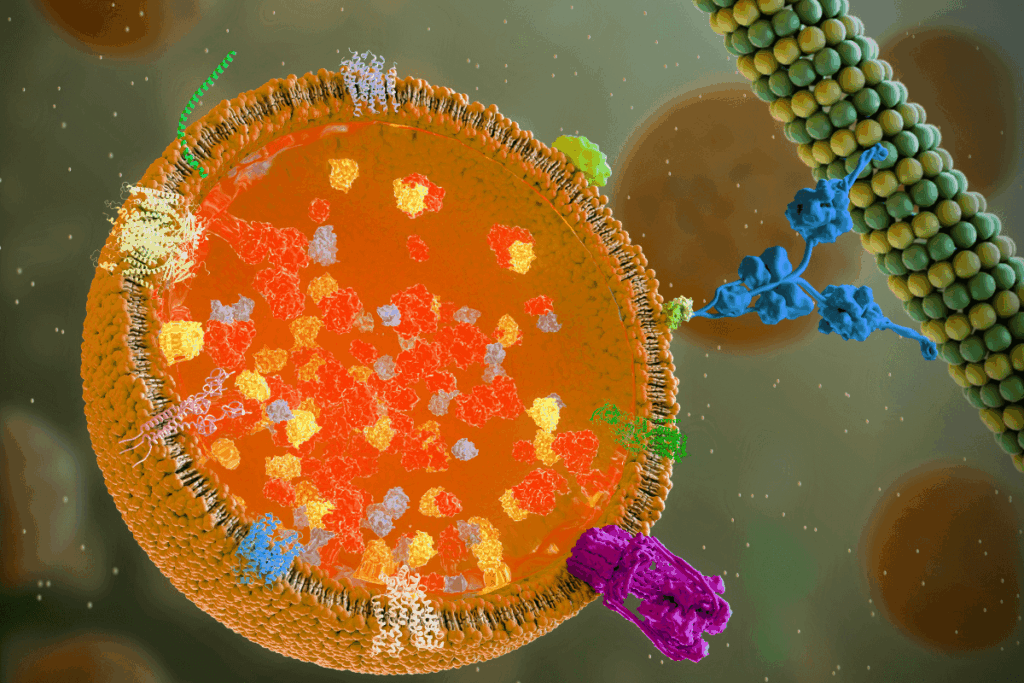
Lysosomes are membrane-bound organelles essential for cellular homeostasis, macromolecule degradation, and organelle turnover. These include luminal hydrolases and membrane-associated regulators. They regulate pH balance, trafficking, degradation, and fusion. Lysosomes also include energy and nutrient sensing. Key pathways include AMPK and mTORC1. They store metals, amino acids, and cholesterol. Lysosomal defects cause lysosomal storage disorders. They also contribute to neurodegenerative diseases. This was well addressed in the current study published in Cell, where the authors generated a brain lysosomal protein atlas. It revealed shared and cell-type-specific proteins. SLC45A1 was identified as neuron-specific. Its loss disrupts mitochondria, acidification, and iron balance. This redefines SLC45A1-associated disease as a lysosomal storage disorder.
Human cell lines induced pluripotent stem cells (iPCs), iPSC-derived neurons and microglia, and mice (female and male) were used to generate cell-type-specific lysosomal proteomes. Genetic tagging, clustered regularly interspaced short palindromic repeats (CRISPR)/CRISPR-associated protein 9 (cas9) editing, lysosome immunoprecipitation (LysoIP), promixity-dependent biotin identification (BioID), and proteomics workflows enabled lysosome isolation and protein identification. Data were acquired by liquid chromatography-tandem mass spectrometry (LC-MS/MS) and analyzed using data-independent acquisition (DIA)-based pipelines, statistical modeling, and classifier-based enrichment analyses under approved ethical guidelines. Differential LysoIP protein abundance across Cre recombinase (Cre) lines was assessed using normalized, log2-transformed proteomics data and linear models for microarray data (limma)-based analysis of variance (ANOVA) with false discovery rate (FDR) correction. Protein-mRNA concordance was evaluated by rank-based similarity analysis of single-cell RNA sequencing (scRNA-seq) data and randomization testing. Comprehensive cellular, functional, imaging, lipidomic, molecular, and metabolomic assays were performed by standardized protocols with appropriate statistical analysis.
Using a LysoTag transgenic mouse crossed with cell-type-specific Cre lines, lysosomes were efficiently isolated in vivo from oligodendrocytes, neurons, microglia, and astrocytes with cell sorting. Complementary in vitro studies using human cell lines and iPSC-derived microglia and neurons enabled cross-species comparison and validation. Label-free DIA mass spectrometry identified 790 LysoIP-enriched proteins, including 170 shared across cell types, of which 82% were previously annotated lysosomal proteins. Overall coverage was high, with 191/213 (90%) known core lysosomal proteins detected and 146/191 (76%) significantly enriched. Gene ontology (GO) analysis demonstrated strong lysosomal specificity, with lysosome over-representation analysis (ORA) core of 477 compared to endosome ORA of 1.98. Comparative analysis revealed that 487 proteins were not previously annotated as lysosomal, several of which were validated experimentally in vitro and in vivo. Normalization to core lysosomal proteins showed broadly conserved composition, yet principal component analysis (PCA) and ANOVA identified distinct cell-type-specific signatures—protein abundance correlated with scRNA-seq profiles, with exceptions suggesting intercellular protein transfer. Disease-focused analysis identified 67 neurodegeneration-associated lysosomal proteins, some showing cell-type-specific enrichment.
This study used TMEM192-3XHA-based LysoIP, which may limit resolution of functionally distinct lysosomal subpopulations; alternative or combinatorial markers could improve specificity. Pan-neuronal Syn1-Cre did not resolve neuronal subtypes, and Cx3cr1-Cre showed leakiness, requiring validation in Fcrls-2A-Cre models. Cargo proteins and intercellular lysosomal transfer require further biochemical validation. Sex-specific effects, behavioral analysis, and roles of additional lysosomal transporters were not examined.
This study concluded that this lysosomal atlas explains cell-type-specific lysosomal functions across the brain and their relevance to neurological disease. Identification of SLC45A1 as a regulator of lysosomal acidity. This study also highlights functional specialization, especially in neurons, which provides a foundation for advancing studies of lysosomal storage disorders and brain lysosomal biology.
Reference: Ghoochani A, Heiby JC, Rawat ES, et al. Cell-type resolved protein atlas of brain lysosomes identifies SLC45A1-associated disease as a lysosomal disorder. Cell. 2026;189:1-18. doi:10.1016/j.cell.2025.12.012