Introduction
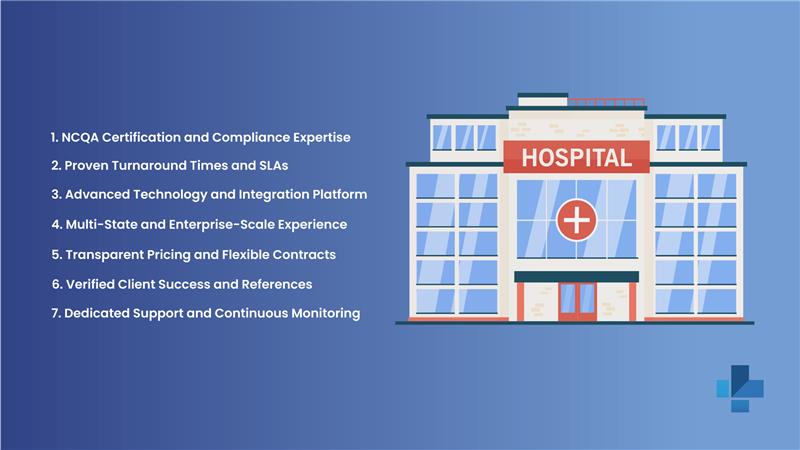
Selecting the right hospital credentialing partner is not a back-office decision; it directly impacts the provider onboarding efficiency, compliance risk, revenue cycle continuity, and patient access to care. Hospitals must choose their credentialing vendors strategically in regard to growing telemedicine, multi-state practice development, and regulatory scrutiny. To assess and choose a credentialing partner that gives speed, compliance, transparency, and a quantifiable ROI, hospitals must follow these 7 crucial criteria.
For more information: How Professional Credentialing Services Streamline Medical Practice Setup
1. NCQA Certification and Compliance Expertise
A top-tier credentialing partner must show extensive knowledge of NCQA credentialing standards, Joint Commission requirements, and payer-specific compliance mandates. Credentialing errors may result in audit findings, reimbursement delay, or network exclusion.
Look for partners who follow primary source verification (PSV) procedures, maintain audit readiness documentation, and stay updated on changes to accreditation standards.
A partner experienced in compliance accreditation decreases administrative complexity and protects your hospital during surveys and payer audits.
For more information: How Licensing Relies on Credentialing and Primary Source Verification
2. Proven Turnaround Times and SLAs
Credentialing delays affect provider start dates and hospital revenue directly. High-performing vendors commit to clear credentialing processing times that typically range from 30 to 60 days on the basis of specialty and payer.
Key indicators to assess:
Documented SLAs with performance guarantees
Historical turnaround benchmarks
Escalation protocols for stalled applications
Vendors who refuse to commit to timelines often lack process maturity or staffing depth.
For more information: How to Simplify Hospital Credentialing for Faster Compliance
3. Advanced Technology and Integration Platform
Manual credentialing processes elevate error rates and slow onboarding. Modern hospitals must prioritize partners by credentialing software for APIs, CAQH automation, and seamless EHR integration.
Technology-driven credentialing enables:
Real-time application tracking
Automated document uploads and verifications
Faster payer submissions and status updates
This is especially important for telemedicine and distributed care models.
For more information: How Hospitals Handle Credentialing for Telehealth Providers
4. Multi-State and Enterprise-Scale Experience
Hospitals operating in regions need partners with proven multi-state credentialing support. Credentialing requirements may differ widely by payer, state, and facility type.
An experienced partner must show:
Knowledge of state medical boards and payers
Capability to handle hospital network services
Expertise in locum tenens credentialing and temporary privileges
Enterprise-scale experience ensures consistency, scalability, and compliance in all facilities.
For more information: How Healthcare Providers Manage Multi-Facility Credentialing
5. Transparent Pricing and Flexible Contracts
Credentialing costs must be consistent and scalable. Avoid vendors with vague pricing structures or restrictive long-term contracts.
Best practices involve:
Clear credentialing cost per provider
Volume discounts for large systems
No-lock-in contracts with flexible exit terms
Transparent pricing allows hospitals to budget accurately and evaluate true vendor value.
For more information: medtigo Medical Licensing & Credentialing Services
6. Verified Client Success and References
Without verification, claims have no meaning. Credentialing vendor reviews, hospital case studies, and precise ROI indicators are all used by reliable credentialing partners to give demonstrable results.
Reduction in onboarding time
Increased provider activation rates
Improved payer enrollment success
Validated performance data signals operational maturity and accountability.
For more information: Who Provides Medical Credentialing Services?
7. Dedicated Support and Continuous Monitoring
Credentialing does not end after approval. Ongoing monitoring prevents lapses, which may lead to claim denials or compliance violations.
Top partners provide:
A dedicated credentialing account manager
Automated expiration alerts
Recredentialing automation and ongoing compliance tracking
medtigo offers dedicated credentialing managers and automated renewal monitoring to ensure uninterrupted provider status.
For more information: Credentialing for Medical Providers: Everything You Need
Conclusion Your RFP Evaluation Checklist
Use the following checklist when evaluating credentialing partners:
- NCQA-compliant credentialing processes
- Guaranteed turnaround times with SLAs
- Technology-enabled workflows and integrations
- multi-state and enterprise experience
- Transparent, flexible pricing
- Proven client success metrics
- Dedicated support and continuous monitoring
Ready to partner?
Contact medtigo for a free credentialing audit and custom quote.
Email support@medtigo.com or visit our services page.
FAQs
1. What RFP questions reveal true credentialing partner capability?
Ask about NCQA compliance methods, average turnaround times, technology integrations, staffing ratios, and real client performance metrics.
2. How do NCQA partners reduce Joint Commission survey risks?
They maintain standardized credentialing workflows, ensure complete primary source verification, and provide audit-ready documentation.
3. What pricing red flags signal poor credentialing vendors?
Hidden fees, unclear per-provider costs, mandatory long-term contracts, and a lack of service-level commitments.
4. How can hospitals measure credentialing partner ROI after 6 months?
Track reduced onboarding time, increased provider activation rates, fewer payer denials, and administrative cost savings.
5. Does medtigo offer free credentialing process audits?
Yes, medtigo provides complimentary credentialing audits to identify gaps, delays, and optimization opportunities.