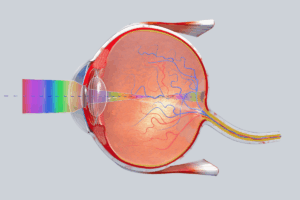
Aphakia means the lack of lenses in the eye. This condition arises from injury, lens displacement, or cataract surgery removal. After cataract surgery, with or without a new lens implant, pupil blockage can happen. A major side effect of older cataract surgeries without proper iris openings was pupil blockage in aphakia patients.
Epidemiology
Pupillary block is a common eye issue in America. It happens after cataract surgery. It can occur soon or years later. Removing cataracts early is key for best sight. Silicone oil injections may raise eye pressure and close the angle in infants. With no lens, pupillary block stops fluid flow. This causes iris bombé, angle closure, synechiae, and optic nerve damage.
Anatomy
Pathophysiology
After cataract surgery, pupillary block is a common type of angle closure. It includes anterior and posterior pupillary blocks. Anterior pupillary blocks happen when the opening of the pupil gets blocked by the anterior hyaloid surface, intraocular lens, or posterior capsule. Posterior synechiae can form between the iris and an intact anterior hyaloid membrane due to inflammation after surgery. Postoperative inflammation also causes iridocapsular adhesions, which prevent aqueous humor from flowing into the anterior chamber. This leads to iris bombé and angle obstruction. Additionally, phacomorphic glaucoma, which is also known as anterior aqueous misdirection perilenticular glaucoma, can cause pupillary block.
Etiology
Some conditions causing aphakic pupillary block are air bubbles, gas bubbles, and vitreous plugging. These can obstruct aqueous humor flow through the pupil. Wound leakage leads to shallow anterior chambers, causing hypotony. Gas bubbles block the pupil passageway. Vascular gel in three phases namely early, moderate, and iridohyloidal, also causes pupillary block. Silicone oil injection aids in retinal reattachment surgery, especially for proliferative vitreoretinopathy cases. But silicone oil accumulating behind the iris can push through the pupil, obstructing superiorly positioned peripheral iridectomies. If oil fills the anterior chamber, pupillary space, and vitreous cavity completely, intraocular pressure (IOP) may rise due to the inability of aqueous humor to reach the trabecular meshwork.
Genetics
Prognostic Factors
When the pupil becomes blocked, treating it promptly improves eyesight. Eye symptoms decrease, and so eye pressure returns to normal levels.
Clinical History
Age: A pupillary block affects babies having surgery for cataracts present at birth. It also impacts the elder people who had removed their intraocular lenses. This occurs in modern times where such lenses get implanted.
Symptoms: Aphakic pupillary block may show symptoms such as painful red eyes, headache, nausea, blurred vision or an acute reduction in vision and vomiting.
Physical Examination
Aphakic pupillary block has several symptoms. These include central depth caused by posterior synechiae, shallowing of anterior chamber, and normal or elevated intraocular pressure (IOP). The pupil might have a mushroom-shaped vitreous plug poking through it. It could also have posterior synechiae or seclusio pupillae. On gonioscopy, the periphery of the iris may curve forward. The iridocorneal angle structures might become obscured in the anterior chamber. Preliminary appositional closure could lead to permanent angle closure over time. Peripheral anterior synechiae (PAS) indicates that this is a chronic condition.
Age group
Associated comorbidity
Iridectomy
Laser iridotomy
Associated activity
Acuity of presentation
Differential Diagnoses
Malignant glaucoma
Choroidal detachment
Laboratory Studies
Imaging Studies
Procedures
Histologic Findings
Staging
Treatment Paradigm
Medical management: Medicines like beta-blockers and prostaglandin analogs decrease eye pressure by slowing fluid production or clearing drainage paths. Medicines like alpha-agonists and carbonic anhydrase inhibitors act similarly. Eye drops that widen pupils can improve fluid flow and rapidly lower pressure in some cases. In emergencies with very high pressure, oral or IV medicines like mannitol can help drain fluid and reduce pressure fast. But these medicines only treat the symptoms, not the actual cause of the high pressure.
Surgical interventions: Neodymium-doped Yttrium Aluminum Garnet (Nd:YAG) laser iridotomy creates a hole in the periphery of the iris. It allows fluid to move freely between the anterior and posterior chambers of the eye. This is the main treatment for aphakic pupillary block. If Nd:YAG laser iridotomy is not possible, a surgical iridectomy may be done. It removes a small part of the iris to create a permanent opening for aqueous humor drainage. Surgery may be needed to restore normal aqueous humor flow and lower intraocular pressure (IOP).
by Stage
by Modality
Chemotherapy
Radiation Therapy
Surgical Interventions
Hormone Therapy
Immunotherapy
Hyperthermia
Photodynamic Therapy
Stem Cell Transplant
Targeted Therapy
Palliative Care
Administration of non-pharmacological approach in treating aphakic pupillary block
Surgical procedures: Surgical treatments help with aphakic pupillary block. They don’t use medication. But these procedures change the iris physically. This makes a channel for fluid flow. So, they’re not pharmaceutical methods.
Dilation of pupil: Eye drops such as mydriatics widen the pupil. This helps fluid inside the eye to flow better. It lowers the chance of pupil blockage. However, this provides short-term relief.
Hyperosmotic agents: If the pupillary block is severe, doctors might give hyperosmotic agents like mannitol or glycerol. These drugs are delivered into the eye or taken by mouth. They quickly lower intraocular pressure, the pressure inside the eyeball. The drugs work by removing fluid from the eye.
Warm compresses: Pupillary block can sometimes get better with massage or gentle pressure on the eye. Warm compresses on the eyelids might also help. The warmth can relax muscles and get blood flowing. This helps the aqueous humor move through the pupil. If muscle tension causes the pupillary block, warm compresses work well.
Patient education and lifestyle modifications: Managing aphakic pupillary block is vital and educating patients on eye care helps immensely. Proper hygiene keeps eyes healthy. Lifestyle changes are beneficial like avoiding heavy lifting and intense exercise, as these raise intraocular pressure.
Use of mydriatic agents
Mydriatic agents like phenylephrine (2.5%) with 25 cyclopentolate for every 15 minutes may be administered in case of eye inflammation or peripheral iridotomy.
Use of carbonic anhydrase inhibitors
Inhibitors of carbonic anhydrase inhibitors such as acetazolamide may be used in treating hazy cornea and inflammation of the eye.
Use of topical beta blockers
Timolol, a beta-blocker, can be used in the treatment of symptoms associated with aphakic pupillary block.
Use of topical alpha antagonsits
Topical preparation containing 1% apraclonidine or 0.15% brimonidine can be used to relieve eye block.
intervention-with-a-procedure
Procedures if the period of angle closure is less than two weeks:
Use of Peripheral iridotomy: The block is often resolved through a hyaloid membrane incision or a peripheral iridotomy may be performed. Sometimes, the vitreous adheres to the back surface of iris, forming many aqueous pockets. In such cases, multiple iridotomies might be necessary.
Use of argon laser iridotomy: This method is used to relieve the pupillary block due to vitreous or other reasons.
Use of photomydriasis or pupilloplasty: Photomydriasis involves using argon laser for pupilloplasty. The doctor applies contracting burns radially around the iris. This creates uniform pupil dilation or localized enlargement in one area. This procedure is used when corneal edema prevents iridotomy. Peripheral iridoplasty can also be performed. Low energy contracting burns deepen the anterior chamber angle. This can be combined with pupilloplasty in few cases.
Use of Nd:YAG: It is an alternative posterior capsulotomy to laser iridotomy in special cases with extraction of extracapsular cataract without involving an intraocular lens.
Use of iris sphincterectomies: This may been employed along with Nd:YAG laser technique.
Procedures to be followed if the length of angle closure is more than 2 weeks.
Specialty: Ophthalmology
Use of Surgical iridectomy: this is a classical technique to treat pupillary block in eyes as laser surgery may not always be successful.
Use of Pars plana vitrectomy: this is another kind of technique that can be used in treating pupillary block.
Use of Trabeculectomy: In case of closed angle, a tube shunt method or trabeculectomy along with antimetabolite may be performed.
Use of Large inferior iridotomy: Aphakic eyes with placement of expansile gas or silicone oil need large inferior iridotomy procedure to reduce the risk of pupillary block.
Aphakic pupillary block causes increased eye pressure (intraocular pressure). Looking at a patient’s eye history, symptoms, tests help diagnosis. Treating it quickly needs antiglaucoma eyedrops, pupil dilating drops, and medications drawing water from eye tissues. Main treatment involves eye surgery or laser to make tiny holes in iris and creating channel for fluid (aqueous humor) flow. Monitoring the treatment is vital. Therapies boosting vision, controlling pressure further, may help some patients.
Aphakia means the lack of lenses in the eye. This condition arises from injury, lens displacement, or cataract surgery removal. After cataract surgery, with or without a new lens implant, pupil blockage can happen. A major side effect of older cataract surgeries without proper iris openings was pupil blockage in aphakia patients.
Pupillary block is a common eye issue in America. It happens after cataract surgery. It can occur soon or years later. Removing cataracts early is key for best sight. Silicone oil injections may raise eye pressure and close the angle in infants. With no lens, pupillary block stops fluid flow. This causes iris bombé, angle closure, synechiae, and optic nerve damage.
After cataract surgery, pupillary block is a common type of angle closure. It includes anterior and posterior pupillary blocks. Anterior pupillary blocks happen when the opening of the pupil gets blocked by the anterior hyaloid surface, intraocular lens, or posterior capsule. Posterior synechiae can form between the iris and an intact anterior hyaloid membrane due to inflammation after surgery. Postoperative inflammation also causes iridocapsular adhesions, which prevent aqueous humor from flowing into the anterior chamber. This leads to iris bombé and angle obstruction. Additionally, phacomorphic glaucoma, which is also known as anterior aqueous misdirection perilenticular glaucoma, can cause pupillary block.
Some conditions causing aphakic pupillary block are air bubbles, gas bubbles, and vitreous plugging. These can obstruct aqueous humor flow through the pupil. Wound leakage leads to shallow anterior chambers, causing hypotony. Gas bubbles block the pupil passageway. Vascular gel in three phases namely early, moderate, and iridohyloidal, also causes pupillary block. Silicone oil injection aids in retinal reattachment surgery, especially for proliferative vitreoretinopathy cases. But silicone oil accumulating behind the iris can push through the pupil, obstructing superiorly positioned peripheral iridectomies. If oil fills the anterior chamber, pupillary space, and vitreous cavity completely, intraocular pressure (IOP) may rise due to the inability of aqueous humor to reach the trabecular meshwork.
When the pupil becomes blocked, treating it promptly improves eyesight. Eye symptoms decrease, and so eye pressure returns to normal levels.
Age: A pupillary block affects babies having surgery for cataracts present at birth. It also impacts the elder people who had removed their intraocular lenses. This occurs in modern times where such lenses get implanted.
Symptoms: Aphakic pupillary block may show symptoms such as painful red eyes, headache, nausea, blurred vision or an acute reduction in vision and vomiting.
Aphakic pupillary block has several symptoms. These include central depth caused by posterior synechiae, shallowing of anterior chamber, and normal or elevated intraocular pressure (IOP). The pupil might have a mushroom-shaped vitreous plug poking through it. It could also have posterior synechiae or seclusio pupillae. On gonioscopy, the periphery of the iris may curve forward. The iridocorneal angle structures might become obscured in the anterior chamber. Preliminary appositional closure could lead to permanent angle closure over time. Peripheral anterior synechiae (PAS) indicates that this is a chronic condition.
Iridectomy
Laser iridotomy
Malignant glaucoma
Choroidal detachment
Medical management: Medicines like beta-blockers and prostaglandin analogs decrease eye pressure by slowing fluid production or clearing drainage paths. Medicines like alpha-agonists and carbonic anhydrase inhibitors act similarly. Eye drops that widen pupils can improve fluid flow and rapidly lower pressure in some cases. In emergencies with very high pressure, oral or IV medicines like mannitol can help drain fluid and reduce pressure fast. But these medicines only treat the symptoms, not the actual cause of the high pressure.
Surgical interventions: Neodymium-doped Yttrium Aluminum Garnet (Nd:YAG) laser iridotomy creates a hole in the periphery of the iris. It allows fluid to move freely between the anterior and posterior chambers of the eye. This is the main treatment for aphakic pupillary block. If Nd:YAG laser iridotomy is not possible, a surgical iridectomy may be done. It removes a small part of the iris to create a permanent opening for aqueous humor drainage. Surgery may be needed to restore normal aqueous humor flow and lower intraocular pressure (IOP).
Surgical procedures: Surgical treatments help with aphakic pupillary block. They don’t use medication. But these procedures change the iris physically. This makes a channel for fluid flow. So, they’re not pharmaceutical methods.
Dilation of pupil: Eye drops such as mydriatics widen the pupil. This helps fluid inside the eye to flow better. It lowers the chance of pupil blockage. However, this provides short-term relief.
Hyperosmotic agents: If the pupillary block is severe, doctors might give hyperosmotic agents like mannitol or glycerol. These drugs are delivered into the eye or taken by mouth. They quickly lower intraocular pressure, the pressure inside the eyeball. The drugs work by removing fluid from the eye.
Warm compresses: Pupillary block can sometimes get better with massage or gentle pressure on the eye. Warm compresses on the eyelids might also help. The warmth can relax muscles and get blood flowing. This helps the aqueous humor move through the pupil. If muscle tension causes the pupillary block, warm compresses work well.
Patient education and lifestyle modifications: Managing aphakic pupillary block is vital and educating patients on eye care helps immensely. Proper hygiene keeps eyes healthy. Lifestyle changes are beneficial like avoiding heavy lifting and intense exercise, as these raise intraocular pressure.
Ophthalmology
Mydriatic agents like phenylephrine (2.5%) with 25 cyclopentolate for every 15 minutes may be administered in case of eye inflammation or peripheral iridotomy.
Ophthalmology
Inhibitors of carbonic anhydrase inhibitors such as acetazolamide may be used in treating hazy cornea and inflammation of the eye.
Ophthalmology
Timolol, a beta-blocker, can be used in the treatment of symptoms associated with aphakic pupillary block.
Ophthalmology
Topical preparation containing 1% apraclonidine or 0.15% brimonidine can be used to relieve eye block.
Ophthalmology
Procedures if the period of angle closure is less than two weeks:
Use of Peripheral iridotomy: The block is often resolved through a hyaloid membrane incision or a peripheral iridotomy may be performed. Sometimes, the vitreous adheres to the back surface of iris, forming many aqueous pockets. In such cases, multiple iridotomies might be necessary.
Use of argon laser iridotomy: This method is used to relieve the pupillary block due to vitreous or other reasons.
Use of photomydriasis or pupilloplasty: Photomydriasis involves using argon laser for pupilloplasty. The doctor applies contracting burns radially around the iris. This creates uniform pupil dilation or localized enlargement in one area. This procedure is used when corneal edema prevents iridotomy. Peripheral iridoplasty can also be performed. Low energy contracting burns deepen the anterior chamber angle. This can be combined with pupilloplasty in few cases.
Use of Nd:YAG: It is an alternative posterior capsulotomy to laser iridotomy in special cases with extraction of extracapsular cataract without involving an intraocular lens.
Use of iris sphincterectomies: This may been employed along with Nd:YAG laser technique.
Procedures to be followed if the length of angle closure is more than 2 weeks.
Specialty: Ophthalmology
Use of Surgical iridectomy: this is a classical technique to treat pupillary block in eyes as laser surgery may not always be successful.
Use of Pars plana vitrectomy: this is another kind of technique that can be used in treating pupillary block.
Use of Trabeculectomy: In case of closed angle, a tube shunt method or trabeculectomy along with antimetabolite may be performed.
Use of Large inferior iridotomy: Aphakic eyes with placement of expansile gas or silicone oil need large inferior iridotomy procedure to reduce the risk of pupillary block.
Ophthalmology
Aphakic pupillary block causes increased eye pressure (intraocular pressure). Looking at a patient’s eye history, symptoms, tests help diagnosis. Treating it quickly needs antiglaucoma eyedrops, pupil dilating drops, and medications drawing water from eye tissues. Main treatment involves eye surgery or laser to make tiny holes in iris and creating channel for fluid (aqueous humor) flow. Monitoring the treatment is vital. Therapies boosting vision, controlling pressure further, may help some patients.
Aphakia means the lack of lenses in the eye. This condition arises from injury, lens displacement, or cataract surgery removal. After cataract surgery, with or without a new lens implant, pupil blockage can happen. A major side effect of older cataract surgeries without proper iris openings was pupil blockage in aphakia patients.
Pupillary block is a common eye issue in America. It happens after cataract surgery. It can occur soon or years later. Removing cataracts early is key for best sight. Silicone oil injections may raise eye pressure and close the angle in infants. With no lens, pupillary block stops fluid flow. This causes iris bombé, angle closure, synechiae, and optic nerve damage.
After cataract surgery, pupillary block is a common type of angle closure. It includes anterior and posterior pupillary blocks. Anterior pupillary blocks happen when the opening of the pupil gets blocked by the anterior hyaloid surface, intraocular lens, or posterior capsule. Posterior synechiae can form between the iris and an intact anterior hyaloid membrane due to inflammation after surgery. Postoperative inflammation also causes iridocapsular adhesions, which prevent aqueous humor from flowing into the anterior chamber. This leads to iris bombé and angle obstruction. Additionally, phacomorphic glaucoma, which is also known as anterior aqueous misdirection perilenticular glaucoma, can cause pupillary block.
Some conditions causing aphakic pupillary block are air bubbles, gas bubbles, and vitreous plugging. These can obstruct aqueous humor flow through the pupil. Wound leakage leads to shallow anterior chambers, causing hypotony. Gas bubbles block the pupil passageway. Vascular gel in three phases namely early, moderate, and iridohyloidal, also causes pupillary block. Silicone oil injection aids in retinal reattachment surgery, especially for proliferative vitreoretinopathy cases. But silicone oil accumulating behind the iris can push through the pupil, obstructing superiorly positioned peripheral iridectomies. If oil fills the anterior chamber, pupillary space, and vitreous cavity completely, intraocular pressure (IOP) may rise due to the inability of aqueous humor to reach the trabecular meshwork.
When the pupil becomes blocked, treating it promptly improves eyesight. Eye symptoms decrease, and so eye pressure returns to normal levels.
Age: A pupillary block affects babies having surgery for cataracts present at birth. It also impacts the elder people who had removed their intraocular lenses. This occurs in modern times where such lenses get implanted.
Symptoms: Aphakic pupillary block may show symptoms such as painful red eyes, headache, nausea, blurred vision or an acute reduction in vision and vomiting.
Aphakic pupillary block has several symptoms. These include central depth caused by posterior synechiae, shallowing of anterior chamber, and normal or elevated intraocular pressure (IOP). The pupil might have a mushroom-shaped vitreous plug poking through it. It could also have posterior synechiae or seclusio pupillae. On gonioscopy, the periphery of the iris may curve forward. The iridocorneal angle structures might become obscured in the anterior chamber. Preliminary appositional closure could lead to permanent angle closure over time. Peripheral anterior synechiae (PAS) indicates that this is a chronic condition.
Iridectomy
Laser iridotomy
Malignant glaucoma
Choroidal detachment
Medical management: Medicines like beta-blockers and prostaglandin analogs decrease eye pressure by slowing fluid production or clearing drainage paths. Medicines like alpha-agonists and carbonic anhydrase inhibitors act similarly. Eye drops that widen pupils can improve fluid flow and rapidly lower pressure in some cases. In emergencies with very high pressure, oral or IV medicines like mannitol can help drain fluid and reduce pressure fast. But these medicines only treat the symptoms, not the actual cause of the high pressure.
Surgical interventions: Neodymium-doped Yttrium Aluminum Garnet (Nd:YAG) laser iridotomy creates a hole in the periphery of the iris. It allows fluid to move freely between the anterior and posterior chambers of the eye. This is the main treatment for aphakic pupillary block. If Nd:YAG laser iridotomy is not possible, a surgical iridectomy may be done. It removes a small part of the iris to create a permanent opening for aqueous humor drainage. Surgery may be needed to restore normal aqueous humor flow and lower intraocular pressure (IOP).
Surgical procedures: Surgical treatments help with aphakic pupillary block. They don’t use medication. But these procedures change the iris physically. This makes a channel for fluid flow. So, they’re not pharmaceutical methods.
Dilation of pupil: Eye drops such as mydriatics widen the pupil. This helps fluid inside the eye to flow better. It lowers the chance of pupil blockage. However, this provides short-term relief.
Hyperosmotic agents: If the pupillary block is severe, doctors might give hyperosmotic agents like mannitol or glycerol. These drugs are delivered into the eye or taken by mouth. They quickly lower intraocular pressure, the pressure inside the eyeball. The drugs work by removing fluid from the eye.
Warm compresses: Pupillary block can sometimes get better with massage or gentle pressure on the eye. Warm compresses on the eyelids might also help. The warmth can relax muscles and get blood flowing. This helps the aqueous humor move through the pupil. If muscle tension causes the pupillary block, warm compresses work well.
Patient education and lifestyle modifications: Managing aphakic pupillary block is vital and educating patients on eye care helps immensely. Proper hygiene keeps eyes healthy. Lifestyle changes are beneficial like avoiding heavy lifting and intense exercise, as these raise intraocular pressure.
Ophthalmology
Mydriatic agents like phenylephrine (2.5%) with 25 cyclopentolate for every 15 minutes may be administered in case of eye inflammation or peripheral iridotomy.
Ophthalmology
Inhibitors of carbonic anhydrase inhibitors such as acetazolamide may be used in treating hazy cornea and inflammation of the eye.
Ophthalmology
Timolol, a beta-blocker, can be used in the treatment of symptoms associated with aphakic pupillary block.
Ophthalmology
Topical preparation containing 1% apraclonidine or 0.15% brimonidine can be used to relieve eye block.
Ophthalmology
Procedures if the period of angle closure is less than two weeks:
Use of Peripheral iridotomy: The block is often resolved through a hyaloid membrane incision or a peripheral iridotomy may be performed. Sometimes, the vitreous adheres to the back surface of iris, forming many aqueous pockets. In such cases, multiple iridotomies might be necessary.
Use of argon laser iridotomy: This method is used to relieve the pupillary block due to vitreous or other reasons.
Use of photomydriasis or pupilloplasty: Photomydriasis involves using argon laser for pupilloplasty. The doctor applies contracting burns radially around the iris. This creates uniform pupil dilation or localized enlargement in one area. This procedure is used when corneal edema prevents iridotomy. Peripheral iridoplasty can also be performed. Low energy contracting burns deepen the anterior chamber angle. This can be combined with pupilloplasty in few cases.
Use of Nd:YAG: It is an alternative posterior capsulotomy to laser iridotomy in special cases with extraction of extracapsular cataract without involving an intraocular lens.
Use of iris sphincterectomies: This may been employed along with Nd:YAG laser technique.
Procedures to be followed if the length of angle closure is more than 2 weeks.
Specialty: Ophthalmology
Use of Surgical iridectomy: this is a classical technique to treat pupillary block in eyes as laser surgery may not always be successful.
Use of Pars plana vitrectomy: this is another kind of technique that can be used in treating pupillary block.
Use of Trabeculectomy: In case of closed angle, a tube shunt method or trabeculectomy along with antimetabolite may be performed.
Use of Large inferior iridotomy: Aphakic eyes with placement of expansile gas or silicone oil need large inferior iridotomy procedure to reduce the risk of pupillary block.
Ophthalmology
Aphakic pupillary block causes increased eye pressure (intraocular pressure). Looking at a patient’s eye history, symptoms, tests help diagnosis. Treating it quickly needs antiglaucoma eyedrops, pupil dilating drops, and medications drawing water from eye tissues. Main treatment involves eye surgery or laser to make tiny holes in iris and creating channel for fluid (aqueous humor) flow. Monitoring the treatment is vital. Therapies boosting vision, controlling pressure further, may help some patients.
Both our subscription plans include Free CME/CPD AMA PRA Category 1 credits.
Digital Certificate PDF
On course completion, you will receive a full-sized presentation quality digital certificate.
medtigo Simulation
A dynamic medical simulation platform designed to train healthcare professionals and students to effectively run code situations through an immersive hands-on experience in a live, interactive 3D environment.
medtigo Points
medtigo points is our unique point redemption system created to award users for interacting on our site. These points can be redeemed for special discounts on the medtigo marketplace as well as towards the membership cost itself.
Community Forum post/reply = 5 points
*Redemption of points can occur only through the medtigo marketplace, courses, or simulation system. Money will not be credited to your bank account. 10 points = $1.
All Your Certificates in One Place
When you have your licenses, certificates and CMEs in one place, it's easier to track your career growth. You can easily share these with hospitals as well, using your medtigo app.