Myopia causes blurred distance vision while close vision remains clear. It allows clear vision of nearby objects but causes difficulty with distant ones.
Myopia is the medical term for near-sightedness. It includes simple myopia and pathologic myopia.
Simple myopia can be corrected with glasses or lenses, but pathologic myopia may not achieve clear vision even with correction.
Myopia can be inherited and developed through lifestyle choices. Individual can read maps but struggle with driving due to vision.
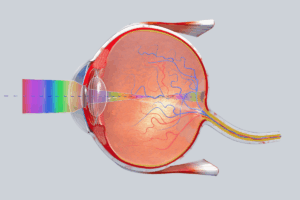
Close-up tasks like reading or using computers can lead to myopia development. When the eyeball is elongated or the cornea is overly curved, light entering the eye misfocusess.
Myopia types as follows:
Simple/school myopia
Degenerative/malignant myopia
Epidemiology
Myopia affects many worldwide, especially in East Asia, where over 80% of young adults are impacted.
It develops in childhood and progresses through adolescence. The rate of progression slows in adulthood.
Myopia is increasingly prevalent globally and, in the U.S., yet limited domestic research exists due to inconsistent definitions.
An estimated 50% of the global population are projected to be myopic by 2050 with nearly 10% at risk of high myopia.
Anatomy
Pathophysiology
Lung axial length relative to optical power causes excessive refractive power in the cornea/lens to light focusing in front of the retina.
Excessive curvature of cornea or lens enhances eye refractive power.
A hypothesis posits that peripheral light focusing behind the retina signals the eye to elongate through retinal signalling pathways.
The retina detects signals, and dopamine prevents excessive elongation through biochemical pathways.
The choroid thins in myopic eyes while near-work activities and low outdoor light contribute to myopia progression.
Etiology
The causes of myopia are:
Genetic Factors
Environmental Factors
Optical Factors
Lifestyle and Behavioral Factors
Genetics
Prognostic Factors
Earlier onset of myopia increases risk of rapid progression and severity in adulthood during growth years.
Children are more likely to develop myopia if one or both parents are myopic.
Higher initial refractive error leads to faster progression, while mild myopia in adults progresses less.
Prolonged near work without breaks accelerates myopia progression significantly.
Clinical History
Collect details including presenting symptoms, vision and medical history to understand clinical history of patient.
Physical Examination
Visual Acuity Testing
Pupil Examination
External Eye Examination
Slit Lamp Examination
Age group
Associated comorbidity
Associated activity
Acuity of presentation
Blurred distance vision, difficulty reading or seeing details, asthenopia, and night vision problems.
Differential Diagnoses
Hyperopia
Astigmatism
Anisometropia
Amblyopia
Laboratory Studies
Imaging Studies
Procedures
Histologic Findings
Staging
Treatment Paradigm
Glasses have been used for centuries to correct/improve blurry distance vision. The concave lens is thinnest in the middle that allows parallel light rays.
Plastic lenses are favoured for their lightweight properties, and polycarbonate lenses protect children’s eyes.
The traditional lens design for myopia blur treatment is single-vision unlike bifocals with two or progressive-addition lenses with gradual power increase.
Rigid gas permeable lenses are hard plastic contact lenses that correct myopic blur and are worn directly on the cornea.
by Stage
by Modality
Chemotherapy
Radiation Therapy
Surgical Interventions
Hormone Therapy
Immunotherapy
Hyperthermia
Photodynamic Therapy
Stem Cell Transplant
Targeted Therapy
Palliative Care
use-of-non-pharmacological-approach-for-myopia
Natural light regulates eye growth and decreases near activity time.
Promote reading by windows and minimize artificial light to reduce eye strain.
Reduce glare and position screens at eye level for good posture.
Proper awareness about myopia should be provided and its related causes with management strategies.
Appointments with an ophthalmologist and preventing recurrence of disorder is an ongoing life-long effort.
Use of Anticholinergic agent
Atropine:
It relaxes the eye’s accommodative muscles and suppresses axial elongation.
Procedures can intervene directly on the eye to manage myopia progression including:
Refractive Surgery
Phakic Intraocular Lenses
Corneal Ring Segments
use-of-phases-in-managing-myopia
In the initial diagnosis phase, the focus is to establish the severity of myopia, progression rate, and any associated risk factors.
Pharmacologic therapy is effective in the treatment phase as it includes the use of anticholinergic agents.
In supportive care and management phase, patients should receive required attention such as lifestyle modification and surgical interventional therapies.
The regular follow-up visits with the ophthalmologist are scheduled to check the improvement of patients along with treatment response.
Myopia causes blurred distance vision while close vision remains clear. It allows clear vision of nearby objects but causes difficulty with distant ones.
Myopia is the medical term for near-sightedness. It includes simple myopia and pathologic myopia.
Simple myopia can be corrected with glasses or lenses, but pathologic myopia may not achieve clear vision even with correction.
Myopia can be inherited and developed through lifestyle choices. Individual can read maps but struggle with driving due to vision.
Close-up tasks like reading or using computers can lead to myopia development. When the eyeball is elongated or the cornea is overly curved, light entering the eye misfocusess.
Myopia types as follows:
Simple/school myopia
Degenerative/malignant myopia
Myopia affects many worldwide, especially in East Asia, where over 80% of young adults are impacted.
It develops in childhood and progresses through adolescence. The rate of progression slows in adulthood.
Myopia is increasingly prevalent globally and, in the U.S., yet limited domestic research exists due to inconsistent definitions.
An estimated 50% of the global population are projected to be myopic by 2050 with nearly 10% at risk of high myopia.
Lung axial length relative to optical power causes excessive refractive power in the cornea/lens to light focusing in front of the retina.
Excessive curvature of cornea or lens enhances eye refractive power.
A hypothesis posits that peripheral light focusing behind the retina signals the eye to elongate through retinal signalling pathways.
The retina detects signals, and dopamine prevents excessive elongation through biochemical pathways.
The choroid thins in myopic eyes while near-work activities and low outdoor light contribute to myopia progression.
The causes of myopia are:
Genetic Factors
Environmental Factors
Optical Factors
Lifestyle and Behavioral Factors
Earlier onset of myopia increases risk of rapid progression and severity in adulthood during growth years.
Children are more likely to develop myopia if one or both parents are myopic.
Higher initial refractive error leads to faster progression, while mild myopia in adults progresses less.
Prolonged near work without breaks accelerates myopia progression significantly.
Collect details including presenting symptoms, vision and medical history to understand clinical history of patient.
Visual Acuity Testing
Pupil Examination
External Eye Examination
Slit Lamp Examination
Blurred distance vision, difficulty reading or seeing details, asthenopia, and night vision problems.
Hyperopia
Astigmatism
Anisometropia
Amblyopia
Glasses have been used for centuries to correct/improve blurry distance vision. The concave lens is thinnest in the middle that allows parallel light rays.
Plastic lenses are favoured for their lightweight properties, and polycarbonate lenses protect children’s eyes.
The traditional lens design for myopia blur treatment is single-vision unlike bifocals with two or progressive-addition lenses with gradual power increase.
Rigid gas permeable lenses are hard plastic contact lenses that correct myopic blur and are worn directly on the cornea.
Ophthalmology
Natural light regulates eye growth and decreases near activity time.
Promote reading by windows and minimize artificial light to reduce eye strain.
Reduce glare and position screens at eye level for good posture.
Proper awareness about myopia should be provided and its related causes with management strategies.
Appointments with an ophthalmologist and preventing recurrence of disorder is an ongoing life-long effort.
Ophthalmology
Atropine:
It relaxes the eye’s accommodative muscles and suppresses axial elongation.
Ophthalmology
Procedures can intervene directly on the eye to manage myopia progression including:
Refractive Surgery
Phakic Intraocular Lenses
Corneal Ring Segments
Ophthalmology
In the initial diagnosis phase, the focus is to establish the severity of myopia, progression rate, and any associated risk factors.
Pharmacologic therapy is effective in the treatment phase as it includes the use of anticholinergic agents.
In supportive care and management phase, patients should receive required attention such as lifestyle modification and surgical interventional therapies.
The regular follow-up visits with the ophthalmologist are scheduled to check the improvement of patients along with treatment response.
Myopia causes blurred distance vision while close vision remains clear. It allows clear vision of nearby objects but causes difficulty with distant ones.
Myopia is the medical term for near-sightedness. It includes simple myopia and pathologic myopia.
Simple myopia can be corrected with glasses or lenses, but pathologic myopia may not achieve clear vision even with correction.
Myopia can be inherited and developed through lifestyle choices. Individual can read maps but struggle with driving due to vision.
Close-up tasks like reading or using computers can lead to myopia development. When the eyeball is elongated or the cornea is overly curved, light entering the eye misfocusess.
Myopia types as follows:
Simple/school myopia
Degenerative/malignant myopia
Myopia affects many worldwide, especially in East Asia, where over 80% of young adults are impacted.
It develops in childhood and progresses through adolescence. The rate of progression slows in adulthood.
Myopia is increasingly prevalent globally and, in the U.S., yet limited domestic research exists due to inconsistent definitions.
An estimated 50% of the global population are projected to be myopic by 2050 with nearly 10% at risk of high myopia.
Lung axial length relative to optical power causes excessive refractive power in the cornea/lens to light focusing in front of the retina.
Excessive curvature of cornea or lens enhances eye refractive power.
A hypothesis posits that peripheral light focusing behind the retina signals the eye to elongate through retinal signalling pathways.
The retina detects signals, and dopamine prevents excessive elongation through biochemical pathways.
The choroid thins in myopic eyes while near-work activities and low outdoor light contribute to myopia progression.
The causes of myopia are:
Genetic Factors
Environmental Factors
Optical Factors
Lifestyle and Behavioral Factors
Earlier onset of myopia increases risk of rapid progression and severity in adulthood during growth years.
Children are more likely to develop myopia if one or both parents are myopic.
Higher initial refractive error leads to faster progression, while mild myopia in adults progresses less.
Prolonged near work without breaks accelerates myopia progression significantly.
Collect details including presenting symptoms, vision and medical history to understand clinical history of patient.
Visual Acuity Testing
Pupil Examination
External Eye Examination
Slit Lamp Examination
Blurred distance vision, difficulty reading or seeing details, asthenopia, and night vision problems.
Hyperopia
Astigmatism
Anisometropia
Amblyopia
Glasses have been used for centuries to correct/improve blurry distance vision. The concave lens is thinnest in the middle that allows parallel light rays.
Plastic lenses are favoured for their lightweight properties, and polycarbonate lenses protect children’s eyes.
The traditional lens design for myopia blur treatment is single-vision unlike bifocals with two or progressive-addition lenses with gradual power increase.
Rigid gas permeable lenses are hard plastic contact lenses that correct myopic blur and are worn directly on the cornea.
Ophthalmology
Natural light regulates eye growth and decreases near activity time.
Promote reading by windows and minimize artificial light to reduce eye strain.
Reduce glare and position screens at eye level for good posture.
Proper awareness about myopia should be provided and its related causes with management strategies.
Appointments with an ophthalmologist and preventing recurrence of disorder is an ongoing life-long effort.
Ophthalmology
Atropine:
It relaxes the eye’s accommodative muscles and suppresses axial elongation.
Ophthalmology
Procedures can intervene directly on the eye to manage myopia progression including:
Refractive Surgery
Phakic Intraocular Lenses
Corneal Ring Segments
Ophthalmology
In the initial diagnosis phase, the focus is to establish the severity of myopia, progression rate, and any associated risk factors.
Pharmacologic therapy is effective in the treatment phase as it includes the use of anticholinergic agents.
In supportive care and management phase, patients should receive required attention such as lifestyle modification and surgical interventional therapies.
The regular follow-up visits with the ophthalmologist are scheduled to check the improvement of patients along with treatment response.
Both our subscription plans include Free CME/CPD AMA PRA Category 1 credits.
Digital Certificate PDF
On course completion, you will receive a full-sized presentation quality digital certificate.
medtigo Simulation
A dynamic medical simulation platform designed to train healthcare professionals and students to effectively run code situations through an immersive hands-on experience in a live, interactive 3D environment.
medtigo Points
medtigo points is our unique point redemption system created to award users for interacting on our site. These points can be redeemed for special discounts on the medtigo marketplace as well as towards the membership cost itself.
Community Forum post/reply = 5 points
*Redemption of points can occur only through the medtigo marketplace, courses, or simulation system. Money will not be credited to your bank account. 10 points = $1.
All Your Certificates in One Place
When you have your licenses, certificates and CMEs in one place, it's easier to track your career growth. You can easily share these with hospitals as well, using your medtigo app.