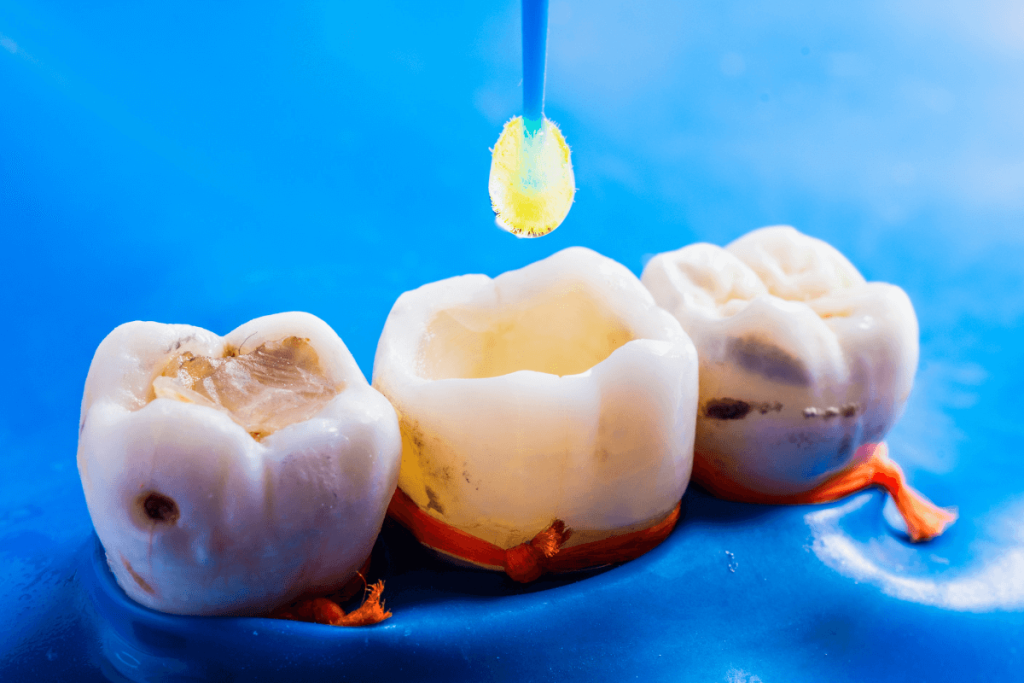
Tooth decay (dental caries) is the most prevalent disease worldwide and has a significant impact on the severe decline of oral health. The most prevalent health issue was untreated dental caries in permanent teeth, which affects around 2 billion people annually. The flexible keratin template structure guides the orderly formation of nanocrystals by promoting the reorganization of secondary structures into α-helices after mineralization. This method shows promise in healing the mechanical and visual characteristics of early dental enamel defects. This study highlighted an effective, easy-to-use, and clinically friendly approach to create new protein-based matrices for the regeneration of hard tissue from natural materials.
Water-based keratin films were used in a straightforward organic approach to replicate the layered dental structure. Keratin, a structural protein found abundantly in wool, is attracting increasing attention in regenerative medicine, which adds to its strength and stability. The stabilization of polypeptide chains was dependent on covalent disulfide bonds, which are created when cysteine residues cross-link with one another.
Lyophilized keratin powder was dissolved at room temperature in Milli-Q water to produce the films. The keratin films were mineralized by mixing 2 mM sodium fluoride and 2 mM HAp powder in deionized water with constant shaking. Concentrated nitric acid (69%) was then added dropwise into the solution gradually until the powder was fully dissolved. An auto sputter coating equipment was used to apply a 10 nm thick layer of gold coating after the samples were mounted using carbon-adhesive tape. After 20 seconds of etching with 35% phosphoric acid, the smear layer was removed with a 20-second washing to create induced defects.
The surface of the enamel developed white spot lesions (WSLs). To ensure that there were no cavities, teeth were inspected using a white light microscope. Alpha correction for multiple comparisons was used in conjunction with Tukey’s HSD post-hoc test and one-way analysis of variance (ANOVA) for comparisons between different groups. It was determined that the entropy component (-TΔS) was 21.6 kcal mol−1, which suggests the binding process is linked to a negative entropy change. The suggested involvement of keratin in biomineralization, while its ability to coordinate calcium ions, can promote nucleation processes under physiological settings.
Self-assembly is a process by which polar side chains interact with water and nonpolar residues create a hydrophobic core to produce keratin films. Initial free cysteine concentrations were greater in water-soluble samples as compared to crosslinked keratin samples, which shows continued disulfide bond formation. The prisms were made of polycrystalline nanocrystals that radiated outward from the centre of the spherulite with average sizes of 83.0 ± 23.0 nm. All samples show the same breakdown initiation at 200 °C and completion at 500 °C, reflecting keratin’s characteristic heat-resistance profile.
During biomineralization, the β-sheet conformation in proteins promotes certain stereochemical interactions with crystal faces. The ability of keratin to restore enamel throughout lesion depth was determined by a mosaic pattern with deeper crystals in crystallographic orientation. The future research should focus on improving the structural tuning of keratin and modifying more acidic domains to increase the affinity of binding minerals.
Reference: Gamea S, Radvar E, Athanasiadou D, et al. Biomimetic mineralization of keratin scaffolds for enamel regeneration. Adv Healthc Mater. 2025:e02465. doi:10.1002/adhm.202502465