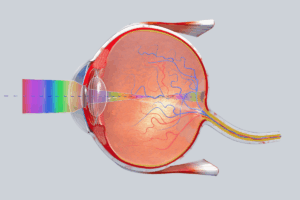
An IOFB would be an object inserted intraocularly that has gone farther than merely passing through the globe and could be wedged in one of the globe layers. The foreign objects can be either shaped, sized, or have varied chemical compositions. They encounter their way through various causes, including industrial hazards, explosions, or high-velocity trauma. Deep penetration into the eye from the IOFBs poses severe optic nerve injury, which demands immediate and demanding cataract surgery to prevent vision loss.
Epidemiology
Ocular injuries impact over 2.4 million persons in the United States. 17 to 41 percent of open globe injuries are caused by intraocular foreign bodies (IOFBs), with young working men making up most of these cases. Remarkably, many of these injuries (13%) had no connection to activities performed at home.
Anatomy
Pathophysiology
Mechanical Damage: Direct Trauma: The injury caused by a foreign body that leads to direct damages of ocular tissues. Secondary Trauma: These are the effects that result from severe complications, which include retinal detachment, vitreous haemorrhage, cataract, and glaucoma. Inflammatory Response: While there is an invader detection and inflammation of being within the globe of an eye, there is a foreign body inside the eye that triggers the ocular tissues. Acute Inflammatory Response: At the beginning the inflammation variant there the immune cells are attracted to injured place releasing various inflammation factors. The scant time may result in valuable injuries to ocular organs. Chronic Inflammatory Response: In the long run, there is the chance that chronic inflammation may occur, thus steeping the process. Therefore, these macular edema complications may give rise to further conditions like uveitis and glaucoma.
Etiology
Occupational Injuries: If working in industries that involve dealing with metal, grinding, hammering,or other activities that make debris, there is a chance of getting foreign bodies inside the eye. The workers of construction industry, particularly, the metal workers, and others who works with machines, are most vulnerable to the work-related injuries. Accidents: IOFBs are usually resulted from various types of traumas including car accidents, explosions, and severe falls. This foreign body can be a random debris due to accident or it can be direct penetration of force causing the foreign object go inside the eye. Projectile Injuries: The bullet’s speed, or the fragments resulting from blast explosions or even the small sliver glass, can produce injuries in the eye tissue or even lead to a rupture of the ocular structure. Penetrating Injuries: Even small foreign bodies, for example pieces of wood, can penetrate the eye as well as notches, bevel corners and notches of knives or scissors and cause intraocular foreign bodies. Sports Injuries: High-risk eye injuries can be incurred while engaging in activities such as shooting which demands the use of guns; and ball sports including Squash, racquetball, the use of projectiles, being some examples. Metallic Injuries: Injuries involving metal-on-metal contact es as hammering metal on metal for example may produce metallic particles which could stick into the eyes. These kinds of injuries are experienced by workers in the industrial sectors more frequently than workers in other sectors.
Genetics
Prognostic Factors
Location and Size of the IOFB: Smaller, non-ferrous, and non-magnetic IOFBs typically have better chances of survival. An important factor in the prognosis is where the IOFB is located inside the eye. The results are typically worse for those in the posterior portion of the eye. Duration Between Injury and Therapy: Results are improved by prompt diagnosis and therapy.
Clinical History
Age group:Though intraocular foreign bodies (IOFBs) can happen at any given age, adults are more likely to have them, the reason behind which is occupational or accidental injuries. However, they can also be found in children, particularly in those who regularly engage in high danger sports or suffered from a traffic accident.
Physical Examination
Visual Acuity
External Examination:
Anterior Segment Examination:
Slit-lamp examination
Age group
Associated comorbidity
Trauma
Occupational workers
Ocular Comorbidities
Associated activity
Acuity of presentation
Acute Presentation:
Pain: An abrupt, intense ache in the eyes Reduction in Visual Acuity: Sudden reduction in visual acuity. Photophobia: Light sensitivity In situations where a metallic foreign body has entered the eye, the wound is visible. Chronic Delay in Presentation: Chronic inflammation or infection in the eyes is known as an inflammatory reaction. Progressive Visual Disturbance: This condition may cause a progressive loss of eyesight if neglected.
Differential Diagnoses
Corneal Foreign Body
Posterior Vitreous Detachment
Cataract:
Intraocular Tumor
Endophthalmitis
Laboratory Studies
Imaging Studies
Procedures
Histologic Findings
Staging
Treatment Paradigm
Medical Management
Antibiotics:
It is recommended to set up a prophylaxis of broad-spectrum antibiotics as prevention. Both topical and oral antibiotics are administered in concern with ophthalmologist.
Anti-Inflammatory Agents:
Anti-inflammatory agents are recommended to treat inflammation and pain associated with the condition.
Surgical Interventions:
Foreign Body Removal: Prompt IOFB extraction from the eye will be essential to stop the progression of the injury to other intraocular structures. For pars plana vitrectomy (or scleral entry), the choice of approach (indirect or straight) will depend on the size, location, and nature of the foreign body. Repair of Associated Injuries: Corneal laceration repairs or retinal detachment repairs are required just during the process of IOFB removal.
Workplace Safety: Engineering Controls: Develop engineering controls aimed at keeping the poorly dispersed particles away from the production & disposal processes. Likewise, putting up barricades, making containers, or putting screens around the cutting and grinding process are some of the methods used to contain the debris they can produce. Good Housekeeping:Maintain an orderly and tidy workspace, so object can be cleared from being fallen for possible injury avoidance. Training and Awareness Programs: Skill-focused training programs that teach the workers about the role of eyes safety and the use of appropriate personal protective equipment. Home Safety: Safe Handling of Tools: Make sure that all the tools and machines are kept under safety to avoid any IOFBs (intra-ocular foreign bodies), which may lead to incidences. Storage of Hazardous Materials: Keep sharp instruments, tools, and hazardous substances in a safe space to avoid accidental injuries to both your workers and yourself.
Use of antibiotics in treating Intraocular Foreign Body
Mostly for gram-positive coverage. A strong Gram-Positive bacteria antibiotic which may prove to be effective against Enterococcus. S treats these conditions is excellent purpose for septicemia and global warning infections.
Use of antifungals in treating Intraocular Foreign Body
Derived from Streptomyces nodosus, this compound can exhibit fungistatic or fungicidal properties. It performs its fungicidal effect by attaching itself to sterols like ergosterol existing in the cell membrane of fungus. This ultimately causes rupturing of the cells and results in cell death.
Small Foreign Body Removal: It may be possible to extract a smaller foreign body and one that is less deep under the skin, with a local anesthetic. Larger or Deeper Foreign Body Removal: larger or deeper objects are mostly treated by a surgical procedure – often performed at the operating room setting. These can include vitrectomy that is an eye surgery to extract some or whole vitreous humor, and may also be combined with other procedures such as cataract surgery, depending on the damage extent and the foreign body type.
Evaluation and Diagnosis:Determine the foreign body’s location and presence. Determine the degree of eye injury. Stabilization:Maintain the patient’s health and stop additional damage from occurring. Control the inflammation and intraocular pressure. Surgical Intervention: Excision of the foreign body through surgery. Fix any eye injuries. Take care of any related issues, such as cataracts or retinal detachment. Short term monitoring:Monitoring for infection or inflammation is part of postoperative care Sustain to ensure appropriate recovery Recuperation and visual restoration. Long-term Monitoring: Frequent examinations to look for side effects such infection, inflammation, or vision problems.
An IOFB would be an object inserted intraocularly that has gone farther than merely passing through the globe and could be wedged in one of the globe layers. The foreign objects can be either shaped, sized, or have varied chemical compositions. They encounter their way through various causes, including industrial hazards, explosions, or high-velocity trauma. Deep penetration into the eye from the IOFBs poses severe optic nerve injury, which demands immediate and demanding cataract surgery to prevent vision loss.
Ocular injuries impact over 2.4 million persons in the United States. 17 to 41 percent of open globe injuries are caused by intraocular foreign bodies (IOFBs), with young working men making up most of these cases. Remarkably, many of these injuries (13%) had no connection to activities performed at home.
Mechanical Damage: Direct Trauma: The injury caused by a foreign body that leads to direct damages of ocular tissues. Secondary Trauma: These are the effects that result from severe complications, which include retinal detachment, vitreous haemorrhage, cataract, and glaucoma. Inflammatory Response: While there is an invader detection and inflammation of being within the globe of an eye, there is a foreign body inside the eye that triggers the ocular tissues. Acute Inflammatory Response: At the beginning the inflammation variant there the immune cells are attracted to injured place releasing various inflammation factors. The scant time may result in valuable injuries to ocular organs. Chronic Inflammatory Response: In the long run, there is the chance that chronic inflammation may occur, thus steeping the process. Therefore, these macular edema complications may give rise to further conditions like uveitis and glaucoma.
Occupational Injuries: If working in industries that involve dealing with metal, grinding, hammering,or other activities that make debris, there is a chance of getting foreign bodies inside the eye. The workers of construction industry, particularly, the metal workers, and others who works with machines, are most vulnerable to the work-related injuries. Accidents: IOFBs are usually resulted from various types of traumas including car accidents, explosions, and severe falls. This foreign body can be a random debris due to accident or it can be direct penetration of force causing the foreign object go inside the eye. Projectile Injuries: The bullet’s speed, or the fragments resulting from blast explosions or even the small sliver glass, can produce injuries in the eye tissue or even lead to a rupture of the ocular structure. Penetrating Injuries: Even small foreign bodies, for example pieces of wood, can penetrate the eye as well as notches, bevel corners and notches of knives or scissors and cause intraocular foreign bodies. Sports Injuries: High-risk eye injuries can be incurred while engaging in activities such as shooting which demands the use of guns; and ball sports including Squash, racquetball, the use of projectiles, being some examples. Metallic Injuries: Injuries involving metal-on-metal contact es as hammering metal on metal for example may produce metallic particles which could stick into the eyes. These kinds of injuries are experienced by workers in the industrial sectors more frequently than workers in other sectors.
Location and Size of the IOFB: Smaller, non-ferrous, and non-magnetic IOFBs typically have better chances of survival. An important factor in the prognosis is where the IOFB is located inside the eye. The results are typically worse for those in the posterior portion of the eye. Duration Between Injury and Therapy: Results are improved by prompt diagnosis and therapy.
Age group:Though intraocular foreign bodies (IOFBs) can happen at any given age, adults are more likely to have them, the reason behind which is occupational or accidental injuries. However, they can also be found in children, particularly in those who regularly engage in high danger sports or suffered from a traffic accident.
Visual Acuity
External Examination:
Anterior Segment Examination:
Slit-lamp examination
Trauma
Occupational workers
Ocular Comorbidities
Acute Presentation:
Pain: An abrupt, intense ache in the eyes Reduction in Visual Acuity: Sudden reduction in visual acuity. Photophobia: Light sensitivity In situations where a metallic foreign body has entered the eye, the wound is visible. Chronic Delay in Presentation: Chronic inflammation or infection in the eyes is known as an inflammatory reaction. Progressive Visual Disturbance: This condition may cause a progressive loss of eyesight if neglected.
Corneal Foreign Body
Posterior Vitreous Detachment
Cataract:
Intraocular Tumor
Endophthalmitis
Medical Management
Antibiotics:
It is recommended to set up a prophylaxis of broad-spectrum antibiotics as prevention. Both topical and oral antibiotics are administered in concern with ophthalmologist.
Anti-Inflammatory Agents:
Anti-inflammatory agents are recommended to treat inflammation and pain associated with the condition.
Surgical Interventions:
Foreign Body Removal: Prompt IOFB extraction from the eye will be essential to stop the progression of the injury to other intraocular structures. For pars plana vitrectomy (or scleral entry), the choice of approach (indirect or straight) will depend on the size, location, and nature of the foreign body. Repair of Associated Injuries: Corneal laceration repairs or retinal detachment repairs are required just during the process of IOFB removal.
Ophthalmology
Workplace Safety: Engineering Controls: Develop engineering controls aimed at keeping the poorly dispersed particles away from the production & disposal processes. Likewise, putting up barricades, making containers, or putting screens around the cutting and grinding process are some of the methods used to contain the debris they can produce. Good Housekeeping:Maintain an orderly and tidy workspace, so object can be cleared from being fallen for possible injury avoidance. Training and Awareness Programs: Skill-focused training programs that teach the workers about the role of eyes safety and the use of appropriate personal protective equipment. Home Safety: Safe Handling of Tools: Make sure that all the tools and machines are kept under safety to avoid any IOFBs (intra-ocular foreign bodies), which may lead to incidences. Storage of Hazardous Materials: Keep sharp instruments, tools, and hazardous substances in a safe space to avoid accidental injuries to both your workers and yourself.
Mostly for gram-positive coverage. A strong Gram-Positive bacteria antibiotic which may prove to be effective against Enterococcus. S treats these conditions is excellent purpose for septicemia and global warning infections.
Derived from Streptomyces nodosus, this compound can exhibit fungistatic or fungicidal properties. It performs its fungicidal effect by attaching itself to sterols like ergosterol existing in the cell membrane of fungus. This ultimately causes rupturing of the cells and results in cell death.
Ophthalmology
Small Foreign Body Removal: It may be possible to extract a smaller foreign body and one that is less deep under the skin, with a local anesthetic. Larger or Deeper Foreign Body Removal: larger or deeper objects are mostly treated by a surgical procedure – often performed at the operating room setting. These can include vitrectomy that is an eye surgery to extract some or whole vitreous humor, and may also be combined with other procedures such as cataract surgery, depending on the damage extent and the foreign body type.
Ophthalmology
Evaluation and Diagnosis:Determine the foreign body’s location and presence. Determine the degree of eye injury. Stabilization:Maintain the patient’s health and stop additional damage from occurring. Control the inflammation and intraocular pressure. Surgical Intervention: Excision of the foreign body through surgery. Fix any eye injuries. Take care of any related issues, such as cataracts or retinal detachment. Short term monitoring:Monitoring for infection or inflammation is part of postoperative care Sustain to ensure appropriate recovery Recuperation and visual restoration. Long-term Monitoring: Frequent examinations to look for side effects such infection, inflammation, or vision problems.
An IOFB would be an object inserted intraocularly that has gone farther than merely passing through the globe and could be wedged in one of the globe layers. The foreign objects can be either shaped, sized, or have varied chemical compositions. They encounter their way through various causes, including industrial hazards, explosions, or high-velocity trauma. Deep penetration into the eye from the IOFBs poses severe optic nerve injury, which demands immediate and demanding cataract surgery to prevent vision loss.
Ocular injuries impact over 2.4 million persons in the United States. 17 to 41 percent of open globe injuries are caused by intraocular foreign bodies (IOFBs), with young working men making up most of these cases. Remarkably, many of these injuries (13%) had no connection to activities performed at home.
Mechanical Damage: Direct Trauma: The injury caused by a foreign body that leads to direct damages of ocular tissues. Secondary Trauma: These are the effects that result from severe complications, which include retinal detachment, vitreous haemorrhage, cataract, and glaucoma. Inflammatory Response: While there is an invader detection and inflammation of being within the globe of an eye, there is a foreign body inside the eye that triggers the ocular tissues. Acute Inflammatory Response: At the beginning the inflammation variant there the immune cells are attracted to injured place releasing various inflammation factors. The scant time may result in valuable injuries to ocular organs. Chronic Inflammatory Response: In the long run, there is the chance that chronic inflammation may occur, thus steeping the process. Therefore, these macular edema complications may give rise to further conditions like uveitis and glaucoma.
Occupational Injuries: If working in industries that involve dealing with metal, grinding, hammering,or other activities that make debris, there is a chance of getting foreign bodies inside the eye. The workers of construction industry, particularly, the metal workers, and others who works with machines, are most vulnerable to the work-related injuries. Accidents: IOFBs are usually resulted from various types of traumas including car accidents, explosions, and severe falls. This foreign body can be a random debris due to accident or it can be direct penetration of force causing the foreign object go inside the eye. Projectile Injuries: The bullet’s speed, or the fragments resulting from blast explosions or even the small sliver glass, can produce injuries in the eye tissue or even lead to a rupture of the ocular structure. Penetrating Injuries: Even small foreign bodies, for example pieces of wood, can penetrate the eye as well as notches, bevel corners and notches of knives or scissors and cause intraocular foreign bodies. Sports Injuries: High-risk eye injuries can be incurred while engaging in activities such as shooting which demands the use of guns; and ball sports including Squash, racquetball, the use of projectiles, being some examples. Metallic Injuries: Injuries involving metal-on-metal contact es as hammering metal on metal for example may produce metallic particles which could stick into the eyes. These kinds of injuries are experienced by workers in the industrial sectors more frequently than workers in other sectors.
Location and Size of the IOFB: Smaller, non-ferrous, and non-magnetic IOFBs typically have better chances of survival. An important factor in the prognosis is where the IOFB is located inside the eye. The results are typically worse for those in the posterior portion of the eye. Duration Between Injury and Therapy: Results are improved by prompt diagnosis and therapy.
Age group:Though intraocular foreign bodies (IOFBs) can happen at any given age, adults are more likely to have them, the reason behind which is occupational or accidental injuries. However, they can also be found in children, particularly in those who regularly engage in high danger sports or suffered from a traffic accident.
Visual Acuity
External Examination:
Anterior Segment Examination:
Slit-lamp examination
Trauma
Occupational workers
Ocular Comorbidities
Acute Presentation:
Pain: An abrupt, intense ache in the eyes Reduction in Visual Acuity: Sudden reduction in visual acuity. Photophobia: Light sensitivity In situations where a metallic foreign body has entered the eye, the wound is visible. Chronic Delay in Presentation: Chronic inflammation or infection in the eyes is known as an inflammatory reaction. Progressive Visual Disturbance: This condition may cause a progressive loss of eyesight if neglected.
Corneal Foreign Body
Posterior Vitreous Detachment
Cataract:
Intraocular Tumor
Endophthalmitis
Medical Management
Antibiotics:
It is recommended to set up a prophylaxis of broad-spectrum antibiotics as prevention. Both topical and oral antibiotics are administered in concern with ophthalmologist.
Anti-Inflammatory Agents:
Anti-inflammatory agents are recommended to treat inflammation and pain associated with the condition.
Surgical Interventions:
Foreign Body Removal: Prompt IOFB extraction from the eye will be essential to stop the progression of the injury to other intraocular structures. For pars plana vitrectomy (or scleral entry), the choice of approach (indirect or straight) will depend on the size, location, and nature of the foreign body. Repair of Associated Injuries: Corneal laceration repairs or retinal detachment repairs are required just during the process of IOFB removal.
Ophthalmology
Workplace Safety: Engineering Controls: Develop engineering controls aimed at keeping the poorly dispersed particles away from the production & disposal processes. Likewise, putting up barricades, making containers, or putting screens around the cutting and grinding process are some of the methods used to contain the debris they can produce. Good Housekeeping:Maintain an orderly and tidy workspace, so object can be cleared from being fallen for possible injury avoidance. Training and Awareness Programs: Skill-focused training programs that teach the workers about the role of eyes safety and the use of appropriate personal protective equipment. Home Safety: Safe Handling of Tools: Make sure that all the tools and machines are kept under safety to avoid any IOFBs (intra-ocular foreign bodies), which may lead to incidences. Storage of Hazardous Materials: Keep sharp instruments, tools, and hazardous substances in a safe space to avoid accidental injuries to both your workers and yourself.
Mostly for gram-positive coverage. A strong Gram-Positive bacteria antibiotic which may prove to be effective against Enterococcus. S treats these conditions is excellent purpose for septicemia and global warning infections.
Derived from Streptomyces nodosus, this compound can exhibit fungistatic or fungicidal properties. It performs its fungicidal effect by attaching itself to sterols like ergosterol existing in the cell membrane of fungus. This ultimately causes rupturing of the cells and results in cell death.
Ophthalmology
Small Foreign Body Removal: It may be possible to extract a smaller foreign body and one that is less deep under the skin, with a local anesthetic. Larger or Deeper Foreign Body Removal: larger or deeper objects are mostly treated by a surgical procedure – often performed at the operating room setting. These can include vitrectomy that is an eye surgery to extract some or whole vitreous humor, and may also be combined with other procedures such as cataract surgery, depending on the damage extent and the foreign body type.
Ophthalmology
Evaluation and Diagnosis:Determine the foreign body’s location and presence. Determine the degree of eye injury. Stabilization:Maintain the patient’s health and stop additional damage from occurring. Control the inflammation and intraocular pressure. Surgical Intervention: Excision of the foreign body through surgery. Fix any eye injuries. Take care of any related issues, such as cataracts or retinal detachment. Short term monitoring:Monitoring for infection or inflammation is part of postoperative care Sustain to ensure appropriate recovery Recuperation and visual restoration. Long-term Monitoring: Frequent examinations to look for side effects such infection, inflammation, or vision problems.
Both our subscription plans include Free CME/CPD AMA PRA Category 1 credits.
Digital Certificate PDF
On course completion, you will receive a full-sized presentation quality digital certificate.
medtigo Simulation
A dynamic medical simulation platform designed to train healthcare professionals and students to effectively run code situations through an immersive hands-on experience in a live, interactive 3D environment.
medtigo Points
medtigo points is our unique point redemption system created to award users for interacting on our site. These points can be redeemed for special discounts on the medtigo marketplace as well as towards the membership cost itself.
Community Forum post/reply = 5 points
*Redemption of points can occur only through the medtigo marketplace, courses, or simulation system. Money will not be credited to your bank account. 10 points = $1.
All Your Certificates in One Place
When you have your licenses, certificates and CMEs in one place, it's easier to track your career growth. You can easily share these with hospitals as well, using your medtigo app.